The influencer marketing stack: building your B2B tech stack in 2026
The five-layer B2B influencer marketing stack: tools, integrations, and what to build first

Most B2B marketing teams have a CRM. Most have a marketing automation platform. Most have a paid media workflow. What most do not have is a coherent, purpose-built influencer marketing stack that connects creator activity to pipeline outcomes. Instead, they have a spreadsheet for tracking outreach, a platform login they rarely use, and a gut feeling that the program is working but cannot prove it.
That gap is expensive. According to the Influencer Marketing Hub 2026 Benchmark Report, the global influencer marketing market reached US$32.55 billion in 2025, 87.49% of brands expect their budgets to increase this year, and only 10.56% of marketers report not using AI in influencer marketing at all. The money is moving and the tools are multiplying. The problem is that most teams are adopting them in isolation rather than as a connected stack.
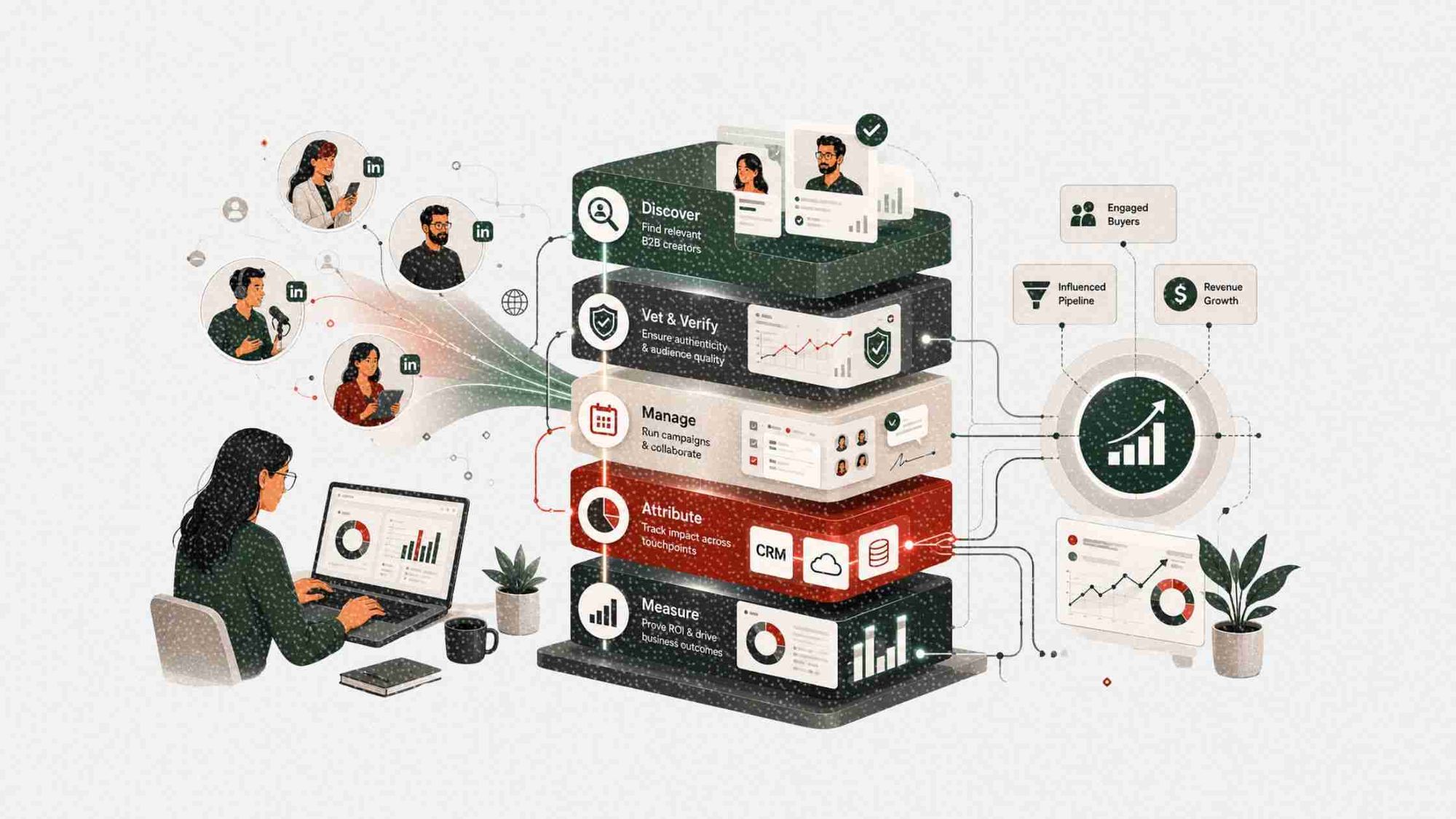
This guide maps the five functional layers of a B2B influencer marketing stack, names the specific tools at each layer, and explains how to wire them together into a system that can prove pipeline influence to a CFO.
Table of contents
Jump to each section:
- Why B2B influencer stacks need a different architecture
- Layer 1: Creator discovery
- Layer 2: Creator vetting and fraud detection
- Layer 3: Campaign management and workflow
- Layer 4: Attribution and CRM integration
- Layer 5: Reporting and intelligence
- How to assemble your stack by program maturity
- What your stack actually needs to prove
Why B2B influencer stacks need a different architecture
Consumer influencer marketing runs on a simple logic: pay a creator, count the impressions, measure the spike in sales within 48 hours. The tools built for that use case reflect it. They prioritize reach databases, engagement rate dashboards, and automated gifting workflows. Almost none of them were designed for a six-person buying committee, a 211-day sales cycle, or the reality that a LinkedIn post viewed in January might show up as closed revenue in September.
B2B influencer marketing needs a different architecture because the conversion event is different. The goal is not a cart add. It is a demo request, a pipeline opportunity, or an enterprise deal influenced across multiple touchpoints. That difference has direct implications for every tool layer in the stack.
For the discovery layer, LinkedIn coverage is non-negotiable. According to LinkedIn's Working with B2B Creators guide, 79% of B2B buyers engage with creator content monthly and 82% say it influences their purchasing decisions. A discovery tool that treats LinkedIn as an afterthought is structurally unfit for B2B.
For the attribution layer, UTM tagging alone is insufficient. You need CRM integration, multi-touch modelling, and intent data correlation to connect creator activity to pipeline. And for the reporting layer, the output has to speak in the language of revenue operations, not impressions.
 Ariana Sorensen
Layer 1: Creator discovery
Creator discovery is where most B2B programs either win or waste budget from the start. The instinct is to look for creators with large followings. The right instinct is to look for creators whose audience matches your ICP. A creator with 8,000 LinkedIn followers where 60% are SaaS founders in your target segment is worth more than a 300,000-follower generalist business commentator whose audience does not contain a single decision-maker at companies you sell to.
The tools at this layer need to do three things well: surface LinkedIn-native creators (not just Instagram and TikTok databases with LinkedIn bolted on), filter by audience composition rather than follower count, and export results into your outreach workflow.
BrandRefer is the most focused LinkedIn-first option at this layer. Built exclusively for LinkedIn B2B influencer campaigns, it provides access to over 800,000 verified B2B professionals, making it the clearest fit for teams whose ICP lives on LinkedIn rather than consumer platforms. For SaaS, fintech, and enterprise software brands where the buying committee is entirely professional, it removes the noise of discovery databases built primarily around lifestyle and consumer categories.
Traackr is the enterprise-grade option for teams running multi-market programs. One of the most established platforms in the category, it is built for organising creator discovery and relationship management at scale across regions. Its Brand Vitality Score measures creator impact across visibility, engagement, and brand trust, giving discovery a quality signal beyond follower count. It also offers ROI and attribution reporting that connects influencer activity to outcomes beyond impressions, making it one of the few platforms where discovery and measurement are genuinely integrated rather than bolted together.
IMAI covers discovery through an AI-powered database with enterprise-level pipeline attribution and CRM integration. For B2B teams that need discovery tied directly into deal-tracking infrastructure, IMAI's architecture reduces the manual handoff between finding creators and attributing their impact to pipeline.
Stormy is a YC-backed agent focused on YouTube and TikTok, with autonomous outreach and negotiation capabilities. For B2B SaaS founders targeting those platforms, it is the most operationally autonomous option available. It connects to Gmail, extracts pricing from creator responses, and counter-offers within preset budget guardrails without manual intervention.
The principle at this layer: build the shortlist around audience composition, not follower volume. Use BrandRefer for LinkedIn-first B2B discovery, Traackr for enterprise multi-market programs, and IMAI where you need discovery wired directly into attribution infrastructure.
Layer 2: Creator vetting and fraud detection
Discovery finds candidates. Vetting decides who actually gets into the program. For B2B marketers, skipping or shortcutting this layer is one of the most expensive mistakes in the stack. The World Federation of Advertisers' 2026 cross-market study of 1,400 senior marketing professionals found that 81% encountered influencer fraud in the past 12 months, with affected campaigns reporting a median budget waste of US$128,000 per mid-scale program. SociaVault's analysis of 100,000 accounts found that 37.2% of influencer followers show signs of being fake, purchased, or inauthentic.
The tools at this layer need to run audience quality analysis, detect fake followers and engagement pods, and provide the kind of output you can screenshot and attach to a creator brief to document your due diligence.
HypeAuditor is the most widely trusted vetting platform, covering Instagram, TikTok, YouTube, and X. Its Audience Quality Score is a single, documented metric that summarises follower authenticity into a defensible number. For enterprise programs, HypeAuditor's reporting format is clean enough to present directly in a budget review.
Traackr serves double duty here. Teams already using it for discovery can apply its audience quality and engagement benchmarking data directly to the vetting decision, reducing the tool count in the stack. Its relationship history layer also makes it easier to document vetting decisions alongside campaign records for audit purposes.
GRIN's Gia uses AI to automate parts of the vetting workflow, including brand safety screening, past content analysis, and performance prediction. It is better suited to enterprise teams running large creator networks than to B2B programs managing ten to twenty creator relationships.
One practical note: macro-tier creators (100,000 to 500,000 followers) carry the highest fraud risk across the industry. SociaVault's data shows this tier has a 48.3% fraud rate. For B2B programs, where a handful of credible micro and mid-tier operators typically outperform a single high-follower macro anyway, this finding reinforces the structural case for focusing discovery on audience quality rather than scale.
Layer 3: Campaign management and workflow
Campaign management tools handle the operational layer of the stack: outreach, contracting, deliverable tracking, content approvals, and payment processing. For B2B programs with a small number of deep creator relationships, this layer can be simple. For programs managing 30-plus creators across multiple campaigns, it becomes critical infrastructure.
The key distinction here is between platforms built for DTC gifting-and-mass-outreach workflows and those that can handle the longer timelines, deeper briefs, and pipeline-tied deliverables that B2B requires.
Influencer Hero covers the full campaign workflow including CRM-style creator relationship management, contract automation, email outreach integration, and performance tracking. At US$649/month for the full workflow tier, it positions itself toward brands running serious ongoing programs rather than one-off campaigns.
CreatorIQ is the enterprise standard for large B2B organisations. Its integration depth into Salesforce and Google Analytics makes it the only platform on this list that can connect campaign management directly into enterprise CRM infrastructure without middleware. Implementation typically runs six to eight weeks for enterprise deployments, but the payoff is a system that removes the data handoff problem between influencer management and the revenue team.
PartnerStack operates at the performance layer of campaign management specifically for B2B. It is built for programs where the conversion event is a demo request, trial, or pipeline opportunity rather than an ecommerce transaction. It syncs with Salesforce and HubSpot, lets you reward creators for demos and trials rather than just closed deals, and provides the affiliate tracking infrastructure that makes performance-based B2B influencer arrangements operationally feasible.
For most B2B teams not yet at enterprise scale, a workflow that combines Traackr or BrandRefer for relationship tracking, a shared Notion or Airtable board for deliverable management, and PartnerStack or impact.com for affiliate-linked performance programs will cover the functional need without the overhead of a full platform deployment.
Layer 4: Attribution and CRM integration
This is the layer where most B2B influencer programs either earn their place in the marketing budget or get cut at the next planning cycle. Attribution is the bridge between creator activity and CFO-acceptable evidence of ROI.
The tools at this layer need to do three things: tag creator-influenced contacts in your CRM from first touch, connect creator content to pipeline through multi-touch attribution modelling, and surface dark-funnel influence signals that UTM-only systems miss entirely.
UTM parameters remain the foundation. Every creator post that links to your site, a landing page, a gated asset, or a demo booking form should carry a creator-specific UTM code. The contact that arrives via that link gets tagged in the CRM as creator-influenced from day one, making it possible to report on pipeline influence rate across the entire program over time.
HubSpot handles this well for mid-market B2B teams. Its native marketing attribution reports can connect UTM-tagged contacts to deal stages, and its workflow automation can trigger creator-influenced lead scoring, nurture sequences, and sales handoff alerts. For teams already on HubSpot, layering influencer attribution into existing workflows is straightforward.
Salesforce is the right infrastructure for enterprise programs. CreatorIQ's native Salesforce integration means creator campaign data flows directly into the CRM without CSV export. For larger organisations running multi-stakeholder influencer programs, Salesforce's reporting depth and custom object capabilities allow attribution modelling that matches the complexity of the actual buying process.
Beyond UTM attribution, intent data tools add a dimension that no creator post link can provide. 6sense and G2 Buyer Intent track anonymous account-level research activity. When target accounts start researching your category in the weeks after a creator campaign, the correlation is not direct attribution, but it is evidence of influence that belongs in the pipeline story.
 Ariana Sorensen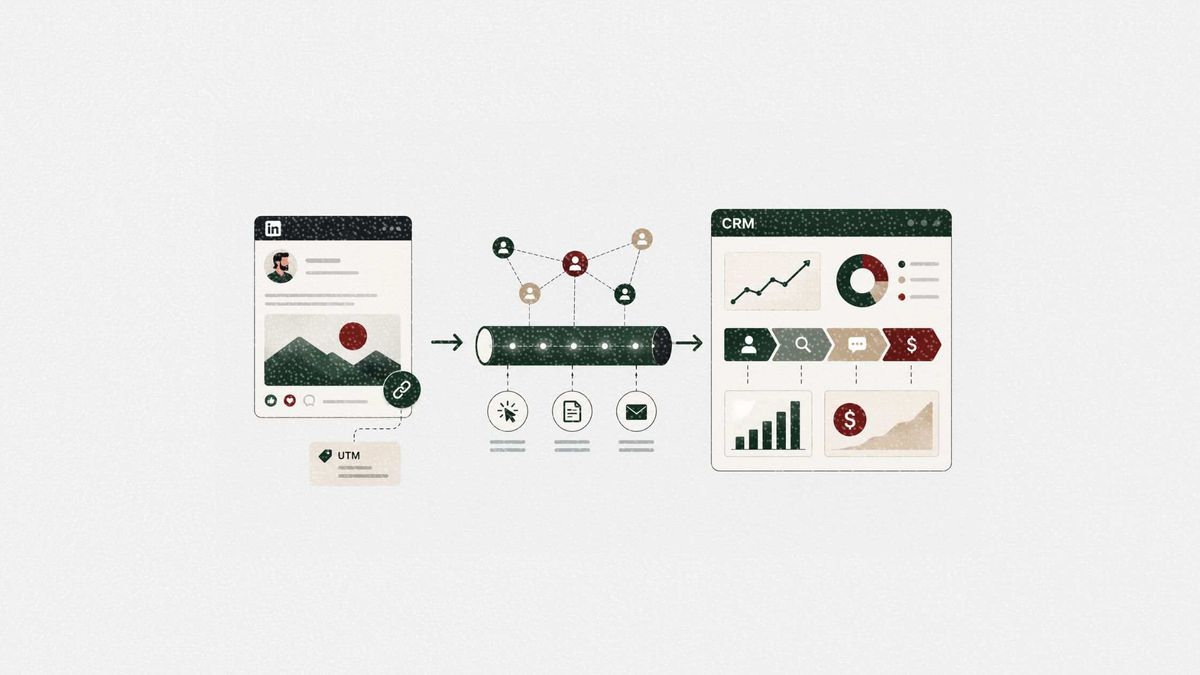
"The attribution challenge is not a tools problem, it is a decision problem," says Dinda Anandita, Account Director at Content Collision, content-led PR agency. "B2B teams that treat influencer activity as a pipeline channel from day one build the tracking infrastructure at the start of the program. Teams that treat it as an awareness play build the spreadsheet justification at the end of the quarter when someone asks what the program returned. Only one of those approaches survives a budget review."
Layer 5: Reporting and intelligence
Reporting is where the stack either earns buy-in or loses it. For B2B influencer programs, the reporting layer has to translate creator activity into the metrics a CFO or revenue-operations leader will accept: pipeline influence rate, cost per influenced opportunity, and creator-influenced deal velocity.
The tools at this layer range from native platform dashboards to business intelligence layers that pull data from across the stack into a single view.
Sprout Social offers both influencer management and cross-channel social analytics, making it useful for B2B teams that need to report on creator performance alongside organic social activity. Its reporting exports are clean enough to drop into a board-level deck without reformatting.
Brandwatch tracks 24 million creators globally and is trusted by two-thirds of Forbes 100 companies. For enterprise teams that need to monitor creator content at scale, track brand mention sentiment alongside campaign performance, and report across multiple creator relationships simultaneously, Brandwatch's intelligence layer adds value that platform-native dashboards cannot replicate.
Supermetrics solves a specific infrastructure problem: pulling creator campaign data from multiple platforms (Sprout, HypeAuditor, LinkedIn Ads, Google Analytics) into a single Google Sheets, Looker Studio, or data warehouse destination. For teams managing tools across discovery, vetting, and attribution that do not natively share data, Supermetrics is the connective tissue that makes a unified dashboard possible without custom engineering.
The reporting metrics that should headline every B2B influencer report: pipeline influence rate (percentage of open deals that touched a creator-influenced contact), cost per influenced opportunity (total program cost divided by influenced opportunities), and creator-influenced deal velocity (whether creator-influenced contacts move through the pipeline faster or slower than the program average).
 Ariana Sorensen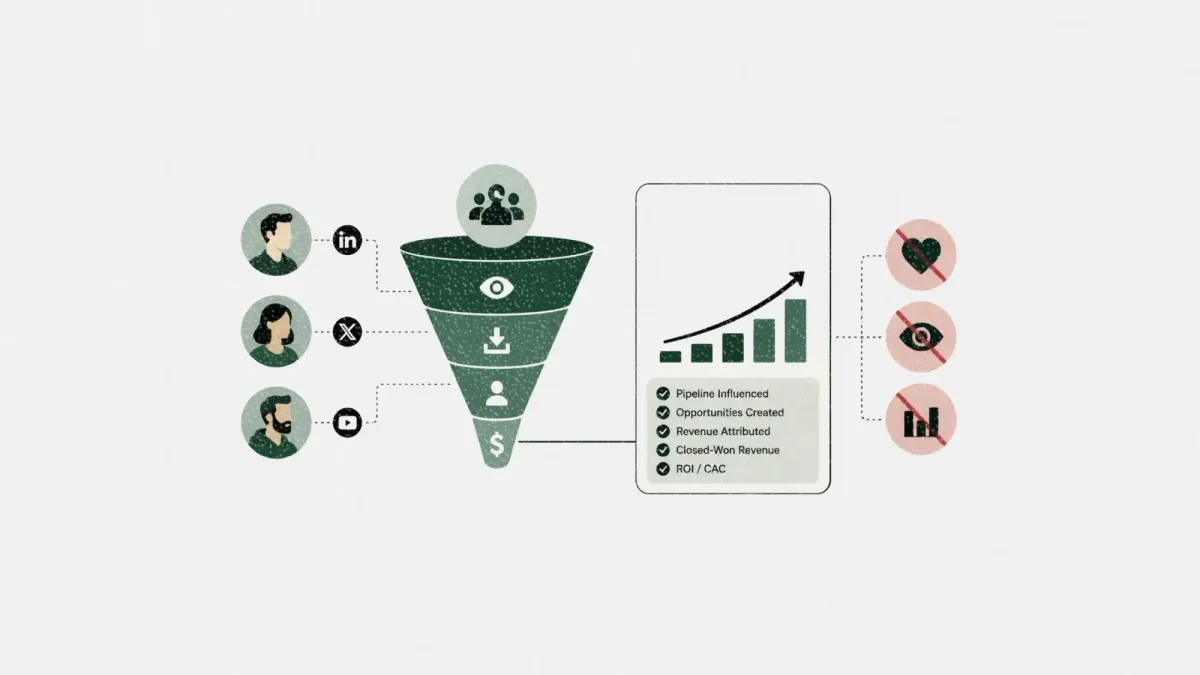
How to assemble your stack by program maturity
Not every B2B team needs every layer fully tooled from day one. The right stack depends on where your program is.
If you are running your first B2B influencer program with a budget under US$50,000, a lean stack works: BrandRefer for LinkedIn-focused discovery, HypeAuditor for spot-check vetting, your existing HubSpot or Salesforce CRM for attribution through UTM tagging, and a shared project management board for deliverable tracking.
Cost: under US$500/month. The output you can produce from this stack is a pipeline influence rate report and a cost per influenced opportunity calculation. That is enough to defend the program budget and earn investment for the next tier of tooling.
At the mid-market level, with programs running US$50,000 to US$250,000 annually, add Traackr for vetting depth and audience analytics, PartnerStack for affiliate-linked performance programs, and Sprout Social or Brandwatch for reporting. This is the stack that makes the program operationally sustainable without requiring dedicated headcount to manage it.
At enterprise scale, above US$250,000, the investment in CreatorIQ's Salesforce integration, combined with 6sense or G2 Buyer Intent for dark funnel correlation, is justified. The data infrastructure at this level produces the kind of defensible attribution evidence that survives the quarterly planning process at large organisations.
One principle holds regardless of program size: assemble the stack in layers, not all at once. Discovery and vetting come first. Attribution infrastructure comes second. Reporting comes third. Adding reporting before the attribution layer is in place produces data that looks good in a slide but cannot survive scrutiny from a revenue operations team.
What your stack actually needs to prove
The architecture question is secondary to the evidence question. Before choosing any tool, the team needs agreement on what the influencer program is supposed to prove and to whom.
For most B2B organisations in 2026, the minimum viable evidence is: creator-influenced contacts enter the pipeline, and they behave differently from non-influenced contacts on at least one metric that matters (close rate, deal velocity, average contract value).
If your stack can produce that comparison, the program has a defensible business case. If it cannot, the program is an awareness investment with a branding rationale, and it will be the first line item cut when marketing budgets tighten.
The good news is that the tooling to produce that evidence is accessible and no longer requires enterprise-scale investment. A HubSpot CRM with UTM-tagged creator contacts, a vetting tool to document audience quality before signing, and a reporting view that filters deals by creator-influence flag is enough to start building the evidence base. The stack can grow as the evidence base grows.
According to the TopRank Marketing 2025 B2B Influencer Marketing Report, B2B teams using an always-on influencer approach rate their programs as effective 99% of the time. The consistent thread across those programs is not platform sophistication. It is measurement discipline applied consistently from the first creator brief to the quarterly pipeline review.