
Localized content is becoming the new battleground for AI search visibility according to Lokalise study
New data shows why multilingual strategy is now central to AI discoverability

AI search is reshaping how content gets discovered, ranked, and surfaced across digital channels. But one variable is quietly becoming decisive: language.
For B2B marketers and PR professionals, the implication is straightforward but not simple. Optimizing for AI search is no longer just about structure, schema, or content depth. It is about where and in what language your brand shows up. And increasingly, English alone is not enough.
This article explores Lokalise’s 2026 AI Search study on how localization is emerging as a core driver of AI search visibility, based on new data from a global study by Lokalise.
Short on time?
Here’s a table of contents for quick access:
- Why localization is becoming central to AI search visibility
- How companies are investing in localized AI search strategies
- What content types are driving AI search visibility across markets
- What marketers should know about scaling localization for AI search
 Patrecia Meliana
Why localization is becoming central to AI search visibility
The data points to a clear shift. Localization is no longer a downstream content task. It is becoming a strategic lever for visibility in AI-generated search results.
According to the study, 63% of global companies are already optimizing localized content specifically for AI search visibility. That means tailoring multilingual content so it can surface in AI-generated answers, recommendations, and summaries.
The payoff is measurable. 45% of companies report stronger AI search visibility in fully localized markets compared to English-only regions. This suggests that AI systems are not just translating content. They are prioritizing relevance at a language and regional level.
There is also growing internal alignment on this shift. 67% of respondents say their belief in localization’s role in AI discoverability has strengthened over the past year, while 55% agree that language strategy meaningfully impacts visibility in non-English markets.
Even more telling, 60% of teams say AI search visibility performance directly influences how they allocate localization budgets across markets.
Patrecia Meliana
How companies are investing in localized AI search strategies
Investment is following belief. Among teams already optimizing for AI search, 73% plan to increase localization spend in the next 12 months.
This signals a transition from experimentation to scale. Localization is moving from a tactical expense to a growth investment tied to discoverability and pipeline impact.
However, not every organization is moving at the same pace. For companies still on the sidelines, budget remains the biggest barrier. 38% cite insufficient budget as the primary obstacle, followed by lack of expertise (32%) and unclear ROI (31%).
There is also a psychological gap. Companies planning to start within 12 months are nearly twice as likely to believe they are already losing AI search visibility compared to those with no plans. That suggests awareness is building faster than execution.
From a market perspective, English still dominates visibility at 97%, but other languages are gaining traction. Spanish, French, Chinese, and German appear as the next most common languages in AI-generated results, though at significantly lower levels.
Patrecia Meliana
What content types are driving AI search visibility across markets
The study also sheds light on what kinds of content are actually being optimized for AI search.
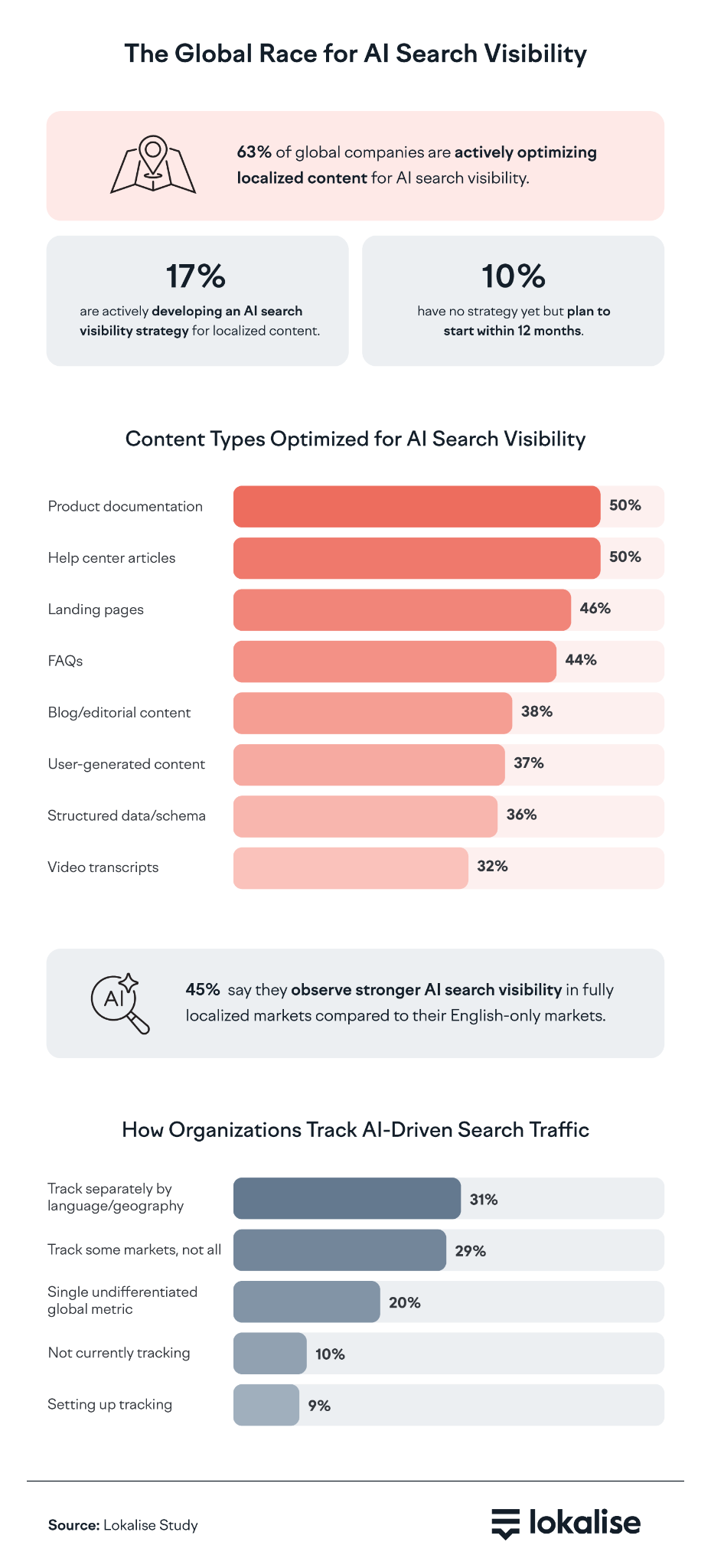
Product documentation and help center articles lead the way at 50% each. This is not surprising. AI systems often prioritize structured, factual, and utility-driven content when generating answers.
Landing pages (46%) and FAQs (44%) follow closely, reinforcing the idea that intent-driven content performs well in AI environments.
More traditional content formats lag behind. Blog and editorial content sits at 38%, while user-generated content and structured data hover in the mid-30% range. Video transcripts come in lowest at 32%.
This distribution highlights a shift in content strategy. AI search rewards clarity, specificity, and structured information over narrative-heavy formats.
On the measurement side, maturity is still uneven. Only 31% of organizations track AI-driven search traffic separately by language or geography. Meanwhile, 20% rely on a single global metric, and 10% are not tracking at all.
This creates a visibility gap. If you are not measuring performance at the market level, you cannot optimize effectively.
Patrecia Meliana
What marketers should know about scaling localization for AI search
For marketers, the takeaway is not just to localize more. It is to localize smarter, with AI search in mind.
Here are a few practical implications:
1. Prioritize high-intent content first
Focus on product documentation, help centers, and FAQs. These formats align closely with how AI systems retrieve and generate answers.
2. Treat language as a performance variable
Do not assume English content will translate into global visibility. Track performance by market and language to identify gaps.
3. Build a measurement framework early
Separate AI-driven traffic by geography. Without this, localization investment becomes guesswork.
4. Align budget with visibility data
If certain markets show stronger AI visibility, use that data to justify increased localization spend.
5. Address capability gaps proactively
Budget is not the only barrier. Talent, tools, and internal alignment are equally critical to scaling localization effectively.
AI search is forcing a rethink of content strategy at a global level. Visibility is no longer just about ranking. It is about being selected and synthesized by AI systems across languages and markets.
The brands that adapt fastest are not just optimizing content. They are investing in localization as a core growth lever.
For marketers, the question is no longer whether to localize. It is how quickly you can operationalize it as part of your AI search strategy.