
Blind boxes are a Gen Z hit, but older shoppers are not buying the hype
GrowthOps Asia’s new research shows why blind boxes are powerful, polarising, and risky when brands overgeneralise Gen Z behaviour.


Blind boxes have entered mainstream shopping behaviour in Malaysia and Singapore, but the audience split is hard to ignore. New research from GrowthOps Asia finds that 55% of Singaporeans and 59% of Malaysians have purchased a blind box before, showing that the mechanic has moved beyond niche collector culture.
 GrowthOps Asia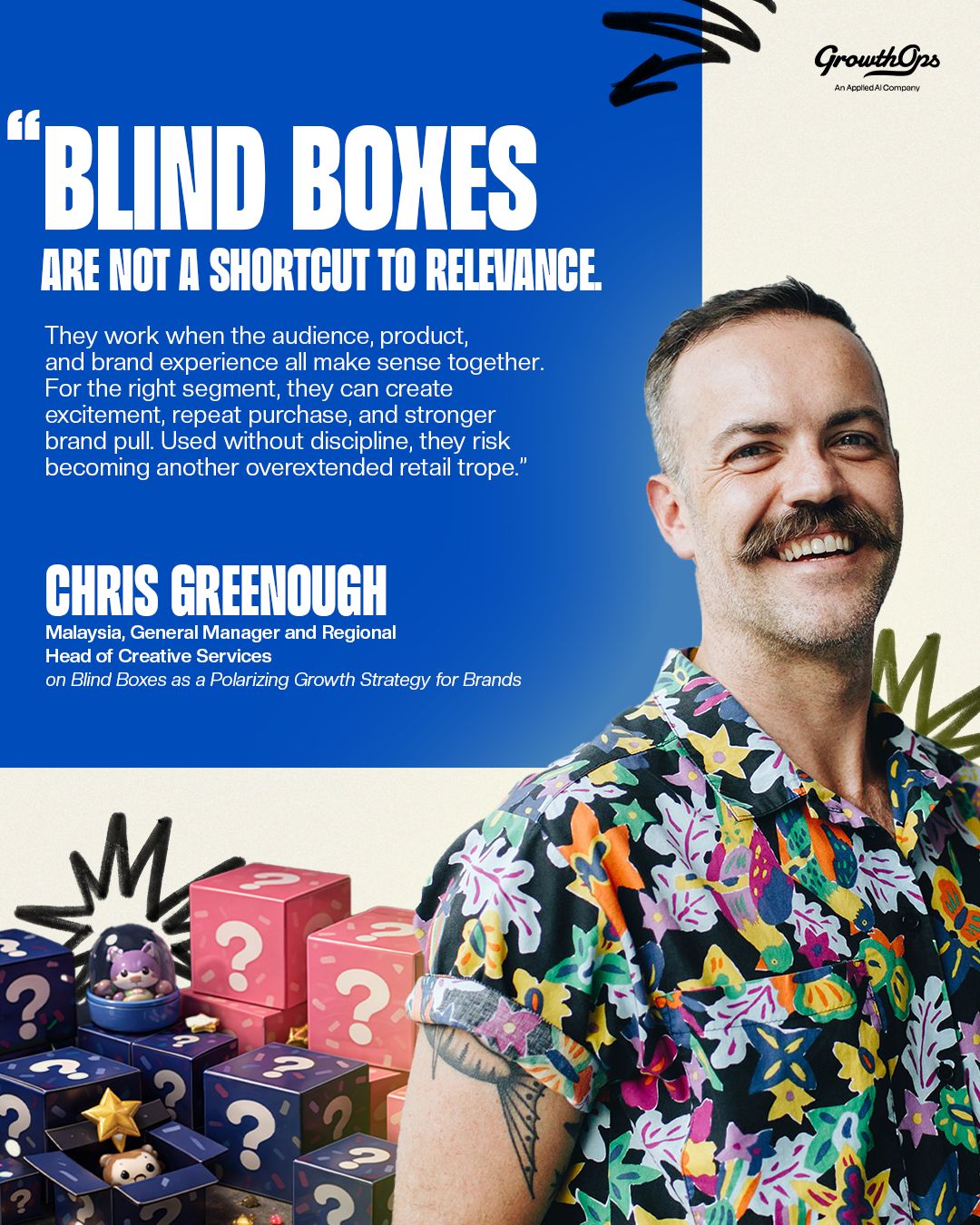
This article explores what the data means for marketers, why Gen Z responds so strongly to mystery-driven retail, and why older consumers may see the same tactic as wasteful, manipulative, or too close to gambling.
Table of contents
Jump to each section:
- What GrowthOps Asia found about blind box adoption
- Why blind boxes work so well with Gen Z
- Why older consumers are pushing back
- What marketers should know before using blind boxes
- Why regulation changes the growth equation
- What this means for brands in Malaysia and Singapore
 Patrecia Meliana
What GrowthOps Asia found about blind box adoption
GrowthOps Asia’s whitepaper, “Blind boxes: A polarising growth strategy,” surveyed 1,352 consumers across Malaysia and Singapore in Q1 2026 with research platform Ideally.
The study found that adoption is strongest among younger consumers. In Singapore, 85% of Gen Z respondents have bought a blind box. In Malaysia, the figure stands at 73%.
The commercial upside is also clear. Existing blind box buyers are about 2.2 times more likely in Singapore and 2.5 times more likely in Malaysia to shop with a brand that offers one.
Why blind boxes work so well with Gen Z
For younger shoppers, blind boxes are not just products. They are content, ritual, and social currency.
The format plays into surprise, fandom, collectability, and shareable consumption. That makes it highly compatible with TikTok-era retail, where the unboxing can matter almost as much as the item itself.
This also connects with the “lipstick effect.” When bigger discretionary purchases feel harder to justify, smaller emotionally rewarding buys can still feel accessible.
Patrecia Meliana
Why older consumers are pushing back
The same mechanics that make blind boxes exciting for Gen Z can trigger distrust among Gen X and Baby Boomers.
Non-buyers in the study described blind boxes as luck-based, wasteful, poor value, and sometimes exploitative. Some respondents compared them to gambling.
That matters because brands cannot assume mystery equals engagement. For some audiences, mystery feels like friction. For others, it feels like a lack of transparency.
What marketers should know before using blind boxes
Blind boxes are not a universal engagement hack. They work best when the audience already understands the category, values collectability, and sees surprise as part of the fun.
Marketers should pressure-test three things before launching:
- Audience fit: Is the target segment already comfortable with fandom, drops, collectibles, or surprise mechanics?
- Category fit: Does the product carry emotional or social value beyond utility?
- Trust fit: Can the brand explain value clearly without making the mechanic feel like a trick?
As Chris Greenough, general manager of GrowthOps Asia, put it: “Blind boxes are not a shortcut to relevance.”
Why regulation changes the growth equation
The policy angle is no longer theoretical. In February 2026, Singapore’s Home Affairs Minister K. Shanmugam confirmed in Parliament that blind boxes would be regulated.
The Ministry of Home Affairs and the Gambling Regulatory Authority are drafting a framework covering how such products are sold, including collectible trading card formats.
For marketers, this adds a compliance layer to what was often treated as a creative retail tactic. Chance-based mechanics now need legal, ethical, and reputational review.
What this means for brands in Malaysia and Singapore
Blind boxes can deepen engagement, increase spend, and create repeat purchase among the right shoppers. But used lazily, they can damage trust.
The sharper takeaway is segmentation. Gen Z may see blind boxes as entertainment. Older consumers may see the same mechanic as poor value or manipulation.
Brands should treat blind boxes as a targeted behavioural trigger, not a broad retail playbook.