
Coach rolls out &Coach, an always-on Gen Z storytelling platform
Coach is positioning &Coach as a long-running, social-first series built with Gen Z collaborators and celebrity voices, shifting from fixed campaigns to many personal narratives anchored in identity and transition.


Coach has rolled out &Coach, an always-on storytelling platform built around Gen Z co-creation, creators, and culture-shaping public figures. The company framed the initiative as a way to move away from fixed luxury campaign narratives and toward more personal, “unfiltered” moments across participants’ lives.
The details were outlined in the company’s official announcement, which positions &Coach as a long-running social-first content series supported by dedicated @and.coach accounts on TikTok and Instagram.
Table of contents
Jump to each section:
- What Coach is trying to change with &Coach
- How the talent and “moment-based” format shapes the creative
- The operating model behind “co-created from the inside out”
- What this means for marketers
 Patrecia Meliana
What Coach is trying to change with &Coach
&Coach is designed as a platform rather than a single campaign. Coach’s stated goal is to reduce reliance on a prescribed, aspiration-led luxury narrative and instead emphasize stories where identity is shaped in real time, with the brand playing a supporting role.
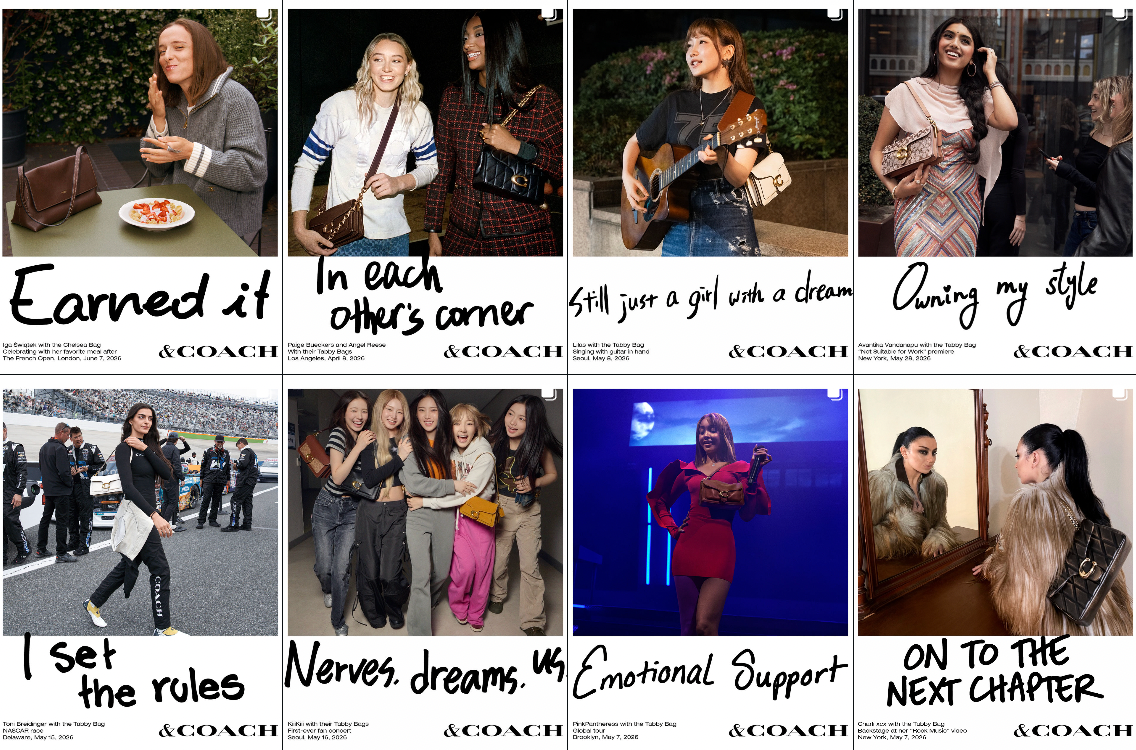
In practical terms, that is a positioning move as much as a content move: Coach is aiming to be “additive” to consumers’ identities, rather than a status symbol. The company also signaled that it expects the platform to evolve via new ambassadors, community participation, and cultural moments over time.
Coach’s parent company, Tapestry (which also owns Kate Spade New York), pointed to recent momentum: Coach revenue rose 31% year over year in Tapestry’s fiscal 2026 Q3 ended March 28, and Tapestry raised its full-year outlook to $7.95 billion in expected sales. That financial backdrop helps explain why the brand is investing in an always-on platform instead of a one-off seasonal push.
 Patrecia Meliana
How the talent and "moment-based" format shapes the creative
The launch roster spans music, sports, film, fashion, and activism, including Charli xcx, Malala Yousafzai, Angel Reese, Paige Bueckers, Toni Breidinger, PinkPantheress, and K-pop group KiiiKiii, among others. The creative concept is built around intimate moments of transition: preparing for a new chapter, dealing with uncertainty, or finding confidence before a high-visibility moment.
That “moment-based” framing matters because it changes what the brand must deliver operationally. Instead of building a single narrative arc, Coach is effectively curating many mini-narratives with consistent brand intent but distinct voices. The company also explicitly described product placement as secondary: bags appear as “companions” that support confidence rather than define identity.
A social-first distribution approach is central to the format. Coach created dedicated @and.coach accounts on TikTok and Instagram as the hub, which is a structural choice that makes creator-led storytelling easier to publish continuously, while also giving the brand a single place to build an audience over time.
https://www.contentgrip.com/5-brands-thriving-with-gen-z-what-theyre-doing-right/
The operating model behind "co-created from the inside out"
Coach described &Coach as developed with a community of Gen Z creative directors and cultural voices across art, fashion, film, and digital culture, plus feedback loops involving “hundreds of consumers globally.” The company also named partners including United Talent Agency’s Next Gen Practice and creative agency Marcel.
For marketers, the key point is that co-creation is being treated as an input to the platform’s development, not just a distribution tactic. That implies ongoing collaboration structures: recurring feedback, rotating contributors, and a format that can absorb new perspectives without needing to “relaunch” creatively each season.
It also creates a higher bar for consistency. If the platform is meant to expand through new voices and culturally relevant moments, the brand has to maintain guardrails around tone, inclusion, and what “unfiltered” means in practice, while still letting each participant’s story stay distinct.
What this means for marketers
Always-on storytelling platforms are easy to label and hard to sustain. &Coach is a useful case study because it combines three pressures marketers increasingly face: audience demand for participation, creator-centric distribution, and the need to keep brand meaning coherent across many narratives.
- Platform thinking needs a clear editorial “center of gravity
”Coach anchors &Coach in identity-in-transition moments (first opportunities, uncertainty, quiet confidence). Marketers building similar platforms should define a repeatable moment framework, not just a theme.
- Talent strategy becomes format strategy
A roster that spans activism, sports, and music can broaden relevance, but it also raises the risk of tonal whiplash. The creative system has to be designed so very different stories still feel like part of one platform.
- Co-creation should be operationalized, not celebrated
Coach emphasized Gen Z collaborators and ongoing feedback loops. That signals resourcing: community management, moderation, approvals, and a pipeline for incorporating input without derailing consistency.
- Social-first “hubs” can clarify ownership and measurement
Creating dedicated TikTok and Instagram accounts makes the platform easier to manage as a product: audience growth, content cadence, and creative learnings can be evaluated without mixing signals with broader brand accounts.
 Patrecia Meliana
In the luxury category, this approach also reflects a wider shift in what “aspiration” is allowed to look like. Instead of polished distance, brands are testing proximity, specificity, and participant-led voice.
For marketing teams outside luxury, the lesson is not “use celebrities” or “make it authentic.” It is about building a repeatable narrative container that can hold many creators without turning into a collage.
If &Coach expands as described, the long-term measure of success will likely be whether the platform can keep attracting new voices and audience participation without losing the core idea that the brand is supporting identity, not prescribing it.