Heinz turns World Cup “cards” into a bigger ketchup packet moment
Heinz’s Penalty Packets remix soccer’s red and yellow cards into double-size ketchup and mustard packets, built for social video and UGC.

Heinz is tapping into a very specific World Cup ritual: the instant recognition of a ref flashing yellow or red. It is one of those universal signals that travels across highlight clips, group chats, and social feeds, even if you are only half-watching the match.
But instead of using the card as a “you’re in trouble” cue, Heinz is using it as a fan-friendly way to call out a different kind of foul: sad, under-sauced food, and those tiny condiment packets that run out after two fries. The company shared the details in an official announcement.
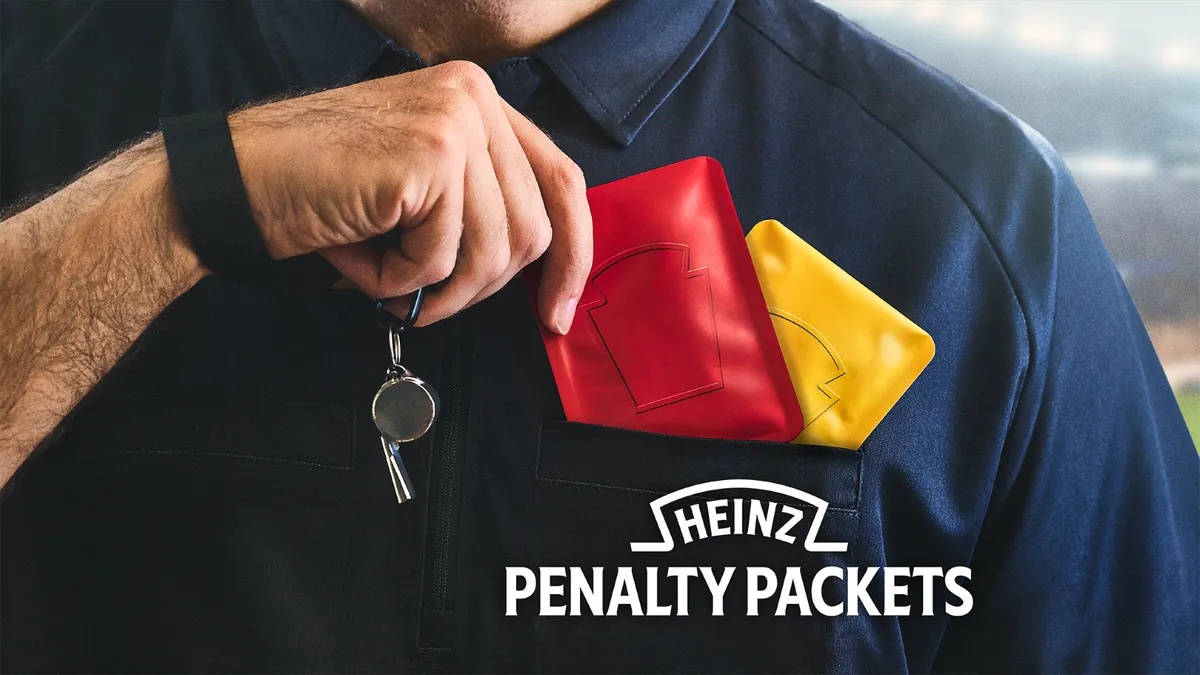
Table of contents
Jump to each section:
- What Heinz is doing with “Penalty Packets”
- Why this works as a social-first World Cup idea
- The distribution and pricing choices matter here
- What this means for marketers
What Heinz is doing with “Penalty Packets”
Heinz’s core campaign asset is “Penalty Packets,” extra-large condiment packets designed to resemble soccer’s yellow and red cards. The packets hold twice the amount of ketchup and mustard compared to standard packets, turning a common consumer frustration (not enough sauce) into a simple prop people can film with.
The creative was developed by Heinz’s in-house agency, The Kitchen, and is positioned as an expansion of the brand’s “Irrational Love” platform, introduced in 2023 to unify its global creative strategy.
The social video concept is straightforward: a sequence of bland-looking foods (like burgers and hot dogs) get “booked” with a red or yellow packet, then rescued with a squeeze of ketchup or mustard. Viewers are encouraged to post with #PenaltyPackets.
 ContentGrip
Why this works as a social-first World Cup idea
The World Cup is already built around symbols that translate instantly on mobile. The “card” is one of the strongest: it is visual, it is dramatic, and it is easy to parody without needing language or deep context. Heinz is essentially borrowing that clarity, then pointing it at a problem everyone has experienced at least once.
The timing also helps. This tournament has seen a record number of red cards, with 13 issued as of July 5, compared with four in 2018 and 2022 combined. When the sport itself is generating more “card discourse,” a brand idea that literally looks like the conversation has a better shot at feeling current rather than bolted on.
There is also a subtle second layer: brands do not need to be official sponsors to show up culturally. Heinz is not an official World Cup sponsor, but it is targeting the same attention pattern fans follow during the final weeks, which is quick-hit social content, highlights, and repeatable bits people can recreate.
The distribution and pricing choices matter here
Heinz is selling Penalty Packets for a limited time via a microsite, packaging the item like a collectible set rather than a commodity refill. Each $1.57 box nods to the “57” on Heinz bottles and includes one red and one yellow packet, plus normal-sized packets positioned as “substitutions.”
That choice does two things. First, it gives the campaign a “buyable proof” that the product idea exists beyond the video. Second, it keeps the creative centered on something tangible that can be shown on camera. In a social-first campaign, the physical object often matters more than the slogan because it is what people hold up to participate.
Heinz has also been navigating FIFA’s “clean stadium” policy, which requires venues to cover or rename brands not associated with the tournament. That dynamic has generated viral images of Heinz bottles taped over. Heinz Canada leaned into that moment by calling itself the “unofficial stadium ketchup,” using the restriction itself as part of the joke.
What this means for marketers
A World Cup campaign like this is not just about sports tie-ins. It is about understanding what fans and casual viewers recognize instantly, and giving them a simple way to “perform” that recognition on social.
- Build around symbols people already know how to use
Yellow and red cards come with built-in behavior. People already understand the gesture, the drama, and the meaning. Heinz just redirected it toward food. - Let the product be the punchline
The oversized packet is the joke and the solution. That matters because the content is more likely to get remade when the prop is obvious and the payoff is visual. - Design for UGC that can be filmed in one take
“Show the card, squeeze the sauce” is easy. No complicated steps, no long explanation, no need for a perfect setting. - If you are not an official sponsor, aim for cultural presence, not logo presence
Heinz is not operating like a sponsor trying to dominate a stadium. It is acting like a brand trying to live in the same feeds where fans are already reacting to the tournament. - Tie the pricing or packaging to the story when you can
The $1.57 detail and the “substitutions” add just enough soccer-specific texture to make the product feel thought through, not generic.
The broader signal is that sports marketing is increasingly “social grammar,” not just sponsorship inventory. If you can translate a live event into a simple, remixable gesture, you can earn attention even when official rules limit how brands show up in venues.
Heinz’s approach is also a reminder that everyday annoyances can be the cleanest creative insight. People do not need a new reason to care about ketchup. They just need a moment that makes them laugh, nod, and think, “Finally, someone said it.”