How influencer marketing helps brands get cited in ChatGPT and Google AI Overviews
How influencer marketing gets your brand cited in ChatGPT and Google AI Overviews

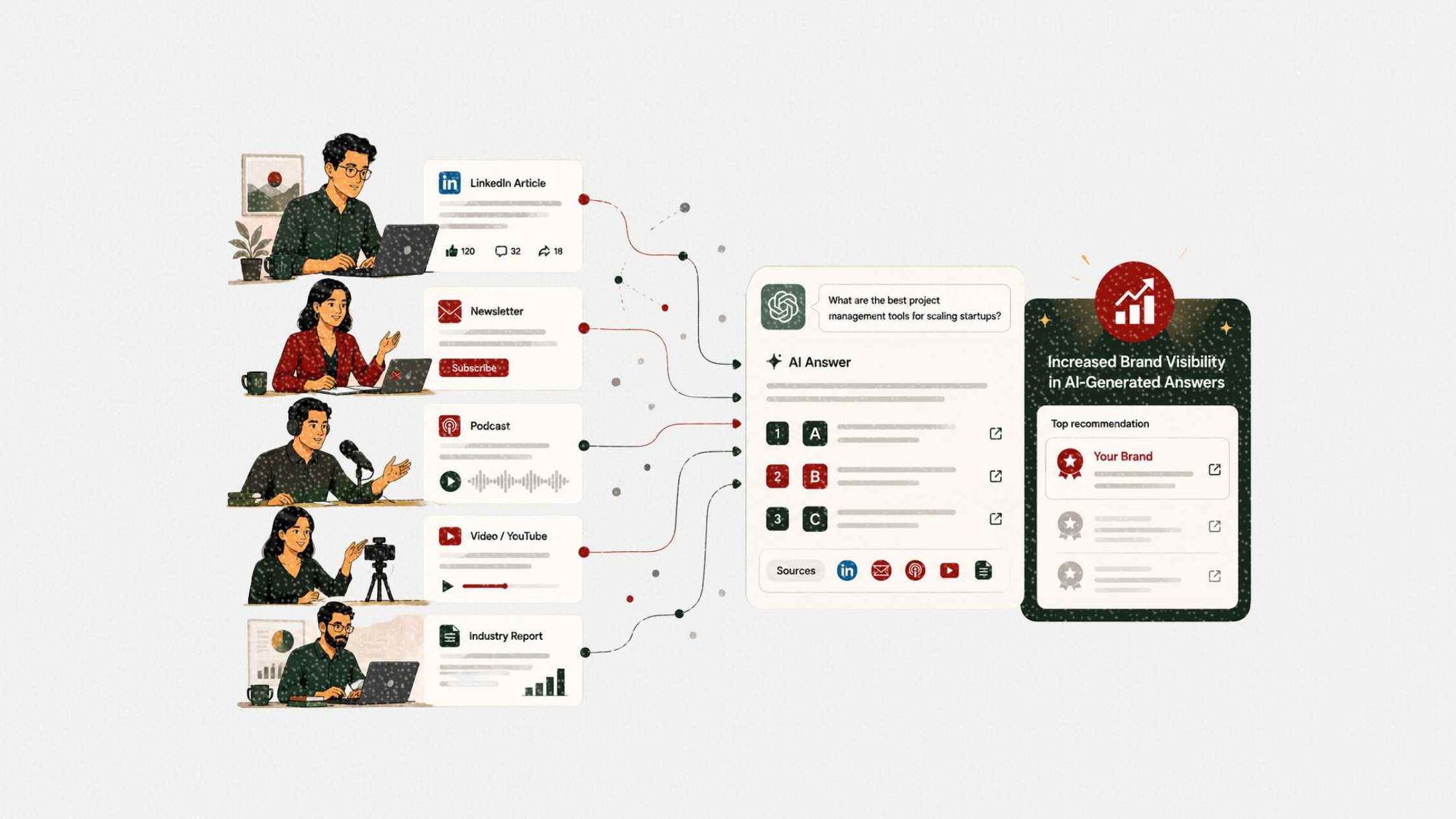
When a B2B buyer asks ChatGPT which marketing software their team should use, they are not clicking through twelve search results. They are reading a synthesized answer and moving on. If your brand is not part of that answer, you are invisible at the moment the decision is forming.
This is the structural shift rewriting how B2B buyers discover vendors, build shortlists, and make purchase decisions. The brands moving fastest are not those doubling down on traditional SEO alone. They are building influencer programs that seed the third-party web with credible, expert content that AI systems trust enough to cite.
This guide explains exactly how that mechanism works, why owned content alone cannot get you into AI answers, and what a B2B influencer program designed for AI search visibility looks like in practice.
Table of contents
Jump to each section:
- Why AI search is the new front door for B2B buyers
- The brand-owned content gap in AI citations
- How influencer content earns citations in ChatGPT and Google AI Overviews
- Building an influencer strategy for AI search visibility
- How to measure your LLM citation share
Why AI search is the new front door for B2B buyers
The numbers are no longer debatable. According to McKinsey's October 2025 report on AI search, half of consumers now intentionally use AI-powered search tools to guide buying decisions, with 44 percent naming AI search their primary source of insight, ahead of traditional search at 31 percent. McKinsey projects that US$750 billion in US revenue will flow through AI search by 2028, and estimates that brands unprepared for the shift stand to lose 20 to 50 percent of their traditional search traffic.
 Ariana Sorensen
For B2B marketers, the stakes are compressed further. The same McKinsey report notes that around 50 percent of Google searches already surface an AI Overview, a figure expected to cross 75 percent by 2028. Add ChatGPT's 800 million weekly active users (as of late 2025) and Perplexity's rapid growth in professional use cases, and it becomes clear: AI is not an emerging channel. It is where vendor shortlists are being built right now.
This is not just a consumer behavior trend. Previsible's 2025 State of AI Discovery Report, which analyzed nearly two million LLM-driven sessions, found that AI-referred sessions surged from 17,076 in January 2025 to 107,100 by May 2025, a 527 percent increase in five months. Legal, finance, health, and B2B professional services accounted for 55 percent of all AI-driven traffic, precisely the verticals where buyers ask consultative, high-stakes questions.
The pattern is consistent: the more complex and high-consideration the purchase, the more buyers turn to AI to pre-process their options. That covers most of what B2B marketing touches.
The practical implication is direct. If a prospect types "best B2B influencer marketing agency" into ChatGPT, Google AI Overviews, or Perplexity, and your brand does not appear in the synthesized response, that prospect may form their shortlist and begin outreach before ever visiting your site. The front door has moved.
The brand-owned content gap in AI citations
Here is where most marketing teams discover an uncomfortable structural problem.
Traditional SEO strategy centers on owned content: your blog, your landing pages, your resource hub. You publish, you optimize, you earn rankings. But when AI systems compile answers, they pull from a far broader and more diverse set of sources than your domain.
McKinsey's research quantifies the gap directly: in many categories, a brand's own website accounts for only 5 to 10 percent of the sources that AI search references. The remainder comes from third-party publishers, affiliates, review platforms, community content, and independent expert voices.
Acceleration Partners research published in October 2025 found that over 80 percent of citations used by LLMs and AI search platforms originate from ad-funded websites and third-party content rather than brand-owned pages. A separate analysis from PR firm 5W, published in May 2026, put the figure at 85.5 percent of AI citations coming from earned media, not brand websites.
These figures point to the same structural reality. AI systems are designed to synthesize perspectives from multiple credible sources, not to amplify brand voices. They weight third-party corroboration over self-promotion. A brand claiming its own product is excellent carries far less citation weight than three independent experts saying the same thing across different high-authority platforms.
This creates a content asymmetry that SEO budgets alone cannot solve. You can publish a perfectly optimized comparison article on your own domain and still be absent from the AI answer if no external voices are reinforcing your category authority.
The solution is not to abandon owned content. It is to recognize that owned content is now one signal in a larger ecosystem of signals, and that third-party, expert-attributed content is the category of signal AI systems trust most. This is exactly what influencer marketing is built to create.
How influencer content earns citations in ChatGPT and Google AI Overviews
To understand why influencer content feeds AI citations, it helps to understand how AI search actually selects sources.
For Google AI Overviews, the foundation is Google's existing search index, meaning content must rank or be indexable in Google to be considered.
For ChatGPT in search mode, Bing's index is the primary source, with content freshness, crawlability, and author credibility as key filters.
Perplexity draws from live web retrieval and weights citations from authoritative, frequently-linked sources. All three systems apply variations of the same underlying logic: credible, non-promotional, expert-attributed, well-structured content on trusted external domains wins citations.
The broader data on how B2B buyers engage with influencer content underlines why this matters. The influencer marketing statistics consistently show that third-party creator content outperforms brand-produced content on trust metrics, and AI citation patterns reflect the same preference at scale.
Influencer content has four structural advantages that match this selection logic exactly.
First, authority through association. When a recognized industry practitioner, a named LinkedIn operator-creator, or a Substack writer with an engaged B2B audience publishes a detailed take on a product category, that content carries a named, verifiable author with a traceable professional history. AI systems processing the web assign greater credibility weight to content tied to identifiable experts than to unsigned brand marketing copy.
Second, platform diversity. A B2B influencer campaign that generates LinkedIn articles, YouTube walkthroughs, independent newsletter editions, podcast episode transcripts, and guest posts on industry publications creates citations distributed across multiple high-trust platforms.
Previsible's data shows that ChatGPT alone accounts for 84.2 percent of AI referral sessions, and ChatGPT actively rewards corroborated signals. Multiple independent voices making the same claim about a brand significantly increases the probability of that claim appearing in an AI answer.
Third, semantic depth. The most citable content, in any AI search context, answers a specific question completely and in plain language. B2B operator-creators who write or speak from genuine product experience naturally produce this kind of content.
A founder-creator who writes "here is exactly how I use this product to solve a specific B2B workflow problem" creates a semantically rich document that AI systems can extract a precise answer from. A brand's own case study page, optimized for conversion rather than clarity, typically cannot.
Fourth, indexability and longevity. LinkedIn articles, Substack posts, and YouTube transcripts are all indexed by Google and Bing. A creator who publishes a substantive review in January 2025 may still be driving AI citations in Q3 2026 if the content remains accurate and the creator retains audience authority. This is earned media that compounds.
The content most valuable for AI citation is the same content that earns organic traffic, social shares, and newsletter links: specific, expert, useful, and clearly attributed. This alignment means that influencer programs designed for AI search visibility create value across multiple channels simultaneously.
Building an influencer strategy for AI search visibility
Designing an influencer program specifically to improve AI search visibility requires a different brief than a standard awareness campaign. Reach metrics matter less. Content format, platform, depth, and indexability matter considerably more.
Start with topic-level mapping, not audience-level mapping. Before identifying creators, map the specific questions your target buyers are asking AI systems in your category. Type those questions into ChatGPT, Perplexity, and Google AI Overviews and note which brands, publications, and creators appear in the answers. These are the sources AI currently trusts in your space. Your influencer strategy needs to get your brand associated with those sources, either by working with the creators already appearing there or by enabling new voices to produce content that competes for the same citations.
Brief for depth, not brand voice. The content brief for AI-citation-oriented influencer work should prioritize substantive answers over messaging alignment. Provide creators with detailed product access, use-case specifics, and any proprietary data that enables them to produce genuinely informative content. Scripted posts and heavily polished brand-aligned copy produce content that AI systems deprioritize. Authentic, experience-based expert commentary is precisely what gets cited.
Prioritize indexable formats. For AI citation, the most valuable content formats are long-form LinkedIn articles (indexed by Google), independent newsletters on platforms like Substack (indexed and frequently cited by Perplexity), YouTube video transcripts (indexed and increasingly cited in AI Overviews), and guest contributions to established industry publications. Short-form social posts produce awareness but rarely generate AI citations. The platform matters as much as the creator.
Work with operator-creators over celebrity influencers. In B2B contexts, the creators who generate AI citations are typically practitioners, not personalities. A SaaS operator with 6,000 LinkedIn followers who writes detailed process content will generate more AI citation value than a marketing celebrity with 200,000 followers who posts brand partnerships. AI systems reward topical authority and content depth, and these are properties operator-creators demonstrate through their body of work.
Combine influencer content with performance structures. A performance-based influencer marketing model, where creators are compensated partly on content outcomes, aligns incentives toward the depth and quality that AI citation rewards. Creators motivated to produce their best work tend to write more specifically, draw on real experience, and update content over time. These are all properties that extend citation longevity.
Activate multiple creators per topic cluster. AI systems weight corroborated signals. A single creator review of your product is a signal. Five independent creator voices across different platforms describing similar experiences creates a pattern that AI systems are far more likely to surface as a reliable answer. Topic-cluster thinking, assigning multiple creators to cover the same category from different angles, is the structural approach that builds durable AI citation share.
Repurpose and amplify creator content across indexable formats. After a creator publishes a substantive article or video, the B2B brand's job is to extend the surface area of that content. Syndicate it to the brand's newsletter, embed it in sales enablement materials, and submit the creator as a guest author to industry publications. Each additional indexation point is another potential entry into the corpus of third-party sources that AI systems draw from. The compounding effect is significant: a single well-placed creator piece, amplified across five different platforms, can generate independent citation signals that reinforce each other in AI responses over months.
Dinda Anandita, Account Director at Content Collision, a content-led PR agency, describes what this shift means for how campaigns are scoped: "The briefing process for AI-visible influencer content looks very different from a standard awareness campaign. We are thinking about which specific questions in a buyer's research journey we want the creator's content to answer, and we are choosing platforms based on whether that content will be indexed and crawlable. It is a more editorial frame than a promotional one, and the brands that adopt it early are building a citation footprint that competitors will struggle to replicate later."
How to measure your LLM citation share
Measuring AI search visibility requires a separate framework from traditional SEO reporting. Standard Google Analytics and Search Console data do not capture most AI citation activity because many AI-referred users never generate a trackable click-through. McKinsey's research calls this the measurement blind spot: AI shapes brand preference and shortlisting upstream of the website visit.
The primary metric to track is share of model (SoM): the percentage of AI-generated responses, across a defined set of queries relevant to your category, in which your brand is mentioned or cited. Tools now exist to measure this systematically.
Profound tracks brand mention frequency across ChatGPT, Perplexity, Gemini, and Google AI Overviews. Similarweb's AI Search Intelligence toolkit provides SoM data across major platforms. AirOps offers LLM brand citation tracking with competitive benchmarking. Meltwater connects AI visibility data with social and influencer signals, which is particularly useful for tracking how influencer activity correlates with citation increases over time.
Beyond SoM, four supporting metrics create a fuller picture.
Citation source analysis tells you which specific URLs are being pulled into AI answers when your brand is mentioned. If an AI cites a creator's LinkedIn article about your product rather than your own case study page, that signals where you should be investing more creator-led content.
Brand mention share tracks how frequently your brand appears compared to competitors across a consistent query set. This is your competitive benchmark and the metric that reveals whether your influencer program is shifting the category narrative in your favor.
Branded search lift is an indirect measure of AI citation impact. When AI tools mention your brand in an answer, users frequently follow up with a branded search in Google to validate what they read. A sustained increase in branded queries that correlates with influencer campaign timing is a strong signal that AI citations are driving upstream influence.
Traffic from AI referrals in GA4 captures the sessions that do click through from AI tools. Set up GA4 to identify referral traffic from domains including openai.com, perplexity.ai, and similar AI search entry points.
Previsible's data indicates this traffic concentrates on high-intent pages such as pricing, tools comparisons, and product detail pages, which makes conversion rate the more important metric than session volume.
 Ariana Sorensen
AI search is not replacing SEO. It is compounding on top of it, and the brands that build influencer programs designed for the third-party trust signals AI systems reward are creating a citation flywheel that self-reinforces over time. The window to be a first mover in this specific tactic remains open, but it will not stay that way.
If your B2B influencer program is currently measured on reach and engagements alone, you are tracking the wrong outputs for the era you are marketing in.