The state of influencer marketing in 2026: 30 stats every B2B marketer should know
30 influencer marketing statistics that reframe how B2B marketers should be spending in 2026

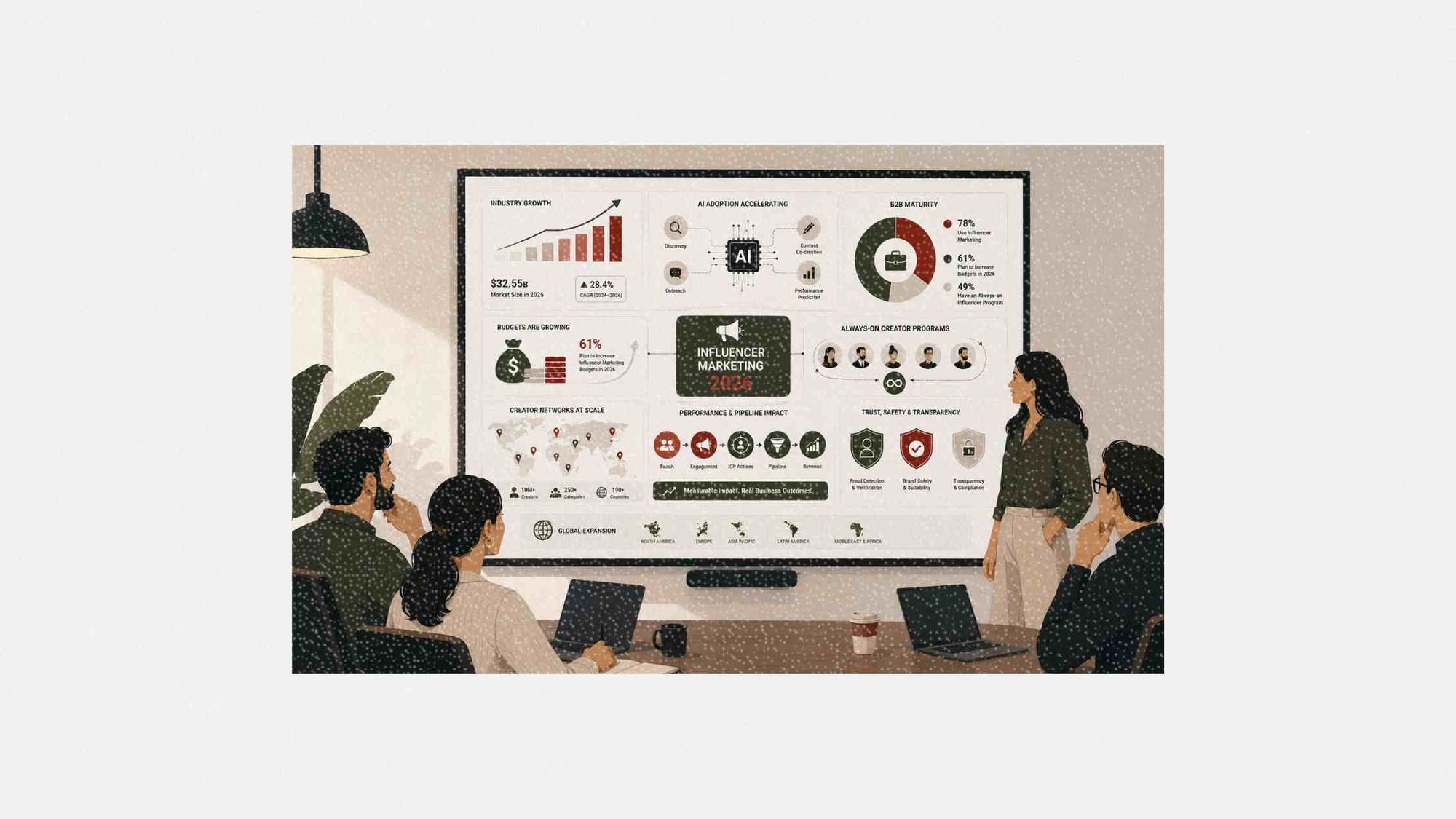
Influencer marketing is no longer a channel brands experiment with between campaigns. It is a core budget line, a performance vehicle, and for B2B marketers, an increasingly measurable driver of pipeline. The data from the past 12 months across Influencer Marketing Hub, Aspire, Sprout Social, TopRank Marketing, AnyMind Group, and the World Federation of Advertisers tells a coherent story: the industry has matured, the money is accelerating, and the operational pressures are growing in step with the ambition.
These 30 statistics are drawn from primary reports published between late 2024 and early 2026. Each one is followed by brief context on why it matters for B2B marketers specifically, not just the broader influencer economy.
Table of contents
Jump to each section:
- Industry size and growth
- Budget commitments: brands are not pulling back
- ROI and performance benchmarks
- AI adoption is past the tipping point
- B2B influencer marketing: the numbers behind the shift
- Fraud is mainstream, not marginal
- APAC: where the numbers diverge
- Read the data, then rewrite your brief
Industry size and growth
1. Influencer marketing reached US$32.55 billion in 2025. Influencer Marketing Hub puts the global market at US$32.55 billion for 2025, up from US$24 billion the prior year. That single-year jump reflects a channel moving from growth phase into institutional status.
2. The industry is projected to surpass US$40 billion in 2026. IMH's forward projections indicate the market clearing US$40 billion this year, representing more than a 20% year-on-year increase. At this scale, influencer marketing is no longer a rounding error in most marketing budgets.
3. US social media creator marketing spend reached US$21.04 billion in 2026, more than doubling since 2022. eMarketer's analysis attributes the growth to brands expanding creator partnerships well beyond sponsored social posts into retail media networks, connected TV, and in-store environments. The US is the world's single largest creator marketing market.
4. Influencer marketing has grown from US$1.4 billion in 2014 to US$32.55 billion in 2025. That is a compound annual growth rate of approximately 33%. Few established advertising channels have sustained anything close to that pace over the same period. The growth argument does not need to be made anymore; the budget conversation now focuses on allocation and accountability.
Budget commitments: brands are not pulling back
5. 87.49% of brands expect their influencer marketing budget to increase in 2026. This is the lead finding from the IMH 2026 Benchmark Report, which surveyed 600-plus marketing professionals. The scale of expansionary intent is notable. Only 5.55% of respondents expected a decrease.
6. 72.22% of those expecting increases plan to grow their budget by 50% or more. This is not incremental growth. More than seven in ten brands planning increases are planning step-change investment. IMH describes the overall direction as "aggressive planned acceleration," not steady consolidation.
7. 74% of marketers plan to actively increase influencer marketing budgets in 2026. Aspire's State of Influencer Marketing 2026, drawing on survey data from nearly 900 marketers and creators, corroborates the IMH findings. The near-universal growth intent across two separate large surveys is a meaningful signal.
8. 66.3% of brands now run influencer programs entirely in-house. The move toward in-house program management, documented in the IMH 2026 Benchmark, reflects maturation rather than cost-cutting. In-house programs are better positioned to integrate influencer data with CRM, attribution, and performance reporting.
9. 65.9% of marketers expect ROI payback within one month, including 48.4% expecting it within two weeks. This finding from IMH 2026 underscores the tension at the heart of the channel right now: budget ambitions are accelerating, but payback expectations are short. For B2B marketers with longer sales cycles, this is a calibration problem worth addressing before a program goes live.
ROI and performance benchmarks
10. Brands earn an average of US$5.78 for every US$1 spent on influencer marketing. IMH's benchmark return figure has been cited widely as a shorthand for channel viability. The reality is messier: top-performing campaigns can return US$11 to US$18 per dollar, while poorly designed programs may show near-zero return. The average masks enormous variance, which is exactly why a B2B ROI framework matters more than a single benchmark figure.
11. 89% of marketers say influencer ROI is equal to or better than other marketing channels. The IMH 2026 report captures a broad sentiment shift: influencer marketing has moved from being something marketers defend in budget meetings to something they use to defend other line items.
12. 86% of consumers make at least one influencer-driven purchase per year. Sprout Social's State of Influencer Marketing report finds that nearly all consumers have been influenced to buy by creator content at some point in a year. Gen Z and millennials do so daily or weekly. The B2B implication is indirect but real: B2B buyers are consumers too, and their trust frameworks carry over.
13. 77% of brands now repurpose creator content in paid ads. The Aspire 2026 data shows the line between organic creator content and paid media has dissolved. When nearly four in five brands are using influencer content in their ad stack, content usage rights have moved from a legal consideration to a core negotiation variable.
14. Creators on Aspire's platform drove US$52 million in attributed affiliate sales in 2025, a 45% year-on-year increase. The Aspire 2026 data captures what the commerce shift looks like at platform scale. Brands without affiliate infrastructure connected to their creator programs are leaving compounding revenue on the table as this segment grows nearly 50% annually.
AI adoption is past the tipping point
15. 59% of marketers are already using AI to scale creator discovery, workflows, and analytics. The Aspire 2026 finding on AI adoption reflects a fundamental workflow shift. AI-powered tools are now handling discovery queries, predicting content performance, and automating reporting tasks that previously required dedicated headcount.
16. Only 10.56% of marketers report not using AI in influencer marketing at all. The IMH 2026 Benchmark puts the non-adopter share below 11%. Teams that are still doing creator discovery manually, evaluating engagement quality by eye, or building performance reports in spreadsheets are operating at a structural disadvantage.
17. 66% of marketers report that AI integration has actively improved their campaign outcomes. The IMH 2026 figure captures what AI adoption translates to in practice: better creator-to-audience fit, faster campaign iteration, and more defensible performance data for stakeholder reporting.
18. 44% of B2B marketers say using AI to expand and optimize influencer content is the most important emerging trend. TopRank Marketing's 2025 B2B Influencer Marketing Report identifies AI content optimization as the top emerging priority for B2B influencer programs specifically. The data suggests B2B marketers see AI less as a discovery tool and more as a content amplification system.
B2B influencer marketing: the numbers behind the shift
19. 85% of B2B marketers now incorporate influencer marketing into their strategy, up from 34% in 2020. The TopRank Marketing 2025 report documents one of the most dramatic adoption curves in B2B marketing history. What was a niche practice five years ago is now close to universal. Understanding what B2B influencer marketing actually entails is no longer optional context.
20. 99% of B2B marketers using an always-on influencer approach rate their programs as effective. The single most predictive variable for B2B influencer program performance, per TopRank 2025, is not budget size or platform choice. It is consistency. Always-on programs maintain continuous creator relationships rather than activating influencers only for campaign bursts.
21. B2B marketers who do not use an always-on approach are 17 times more likely to describe their program as ineffective. The 17x gap is one of the starkest findings in the TopRank data and one of the most actionable. A program that runs three campaign activations a year and nothing in between is not an influencer program. It is three expensive experiments.
22. 67% of B2B brands cite brand awareness as their top influencer marketing goal; 54% cite credibility and trust. Sprout Social's Q1 2025 Pulse Survey of B2B marketers shows awareness and trust consistently outranking revenue as primary goals. This creates a measurement problem: the KPIs most B2B brands use to evaluate influencer spend do not map cleanly to the goals they claim to care about most.
23. 53% of B2B influencer marketing budgets are growing in 2025, according to data from TopRank Marketing and Ascend2. Budget growth at the B2B level is running ahead of broader marketing budget trends, which tracks with the adoption curve. Brands that entered the channel in 2022 or 2023 are now in scaling mode.
24. 43% of all B2B marketers report outstanding results from their influencer programs. Among teams with mature programs, that figure rises to 79%. The maturity gap in TopRank's 2025 data is the most important finding for B2B teams evaluating where their program sits. Excellent results are not random; they correlate with program structure, always-on consistency, and measurement sophistication.
"B2B influencer marketing has crossed from experimental to strategic," says Dinda Anandita, Account Director at Content Collision. "The brands seeing the highest returns right now are not the ones with the biggest budgets. They are the ones who have built genuine long-term relationships with the right creators and can actually attribute what those relationships produce in pipeline terms. That is the maturity gap the TopRank data keeps identifying."
Fraud is mainstream, not marginal
25. 81% of senior marketers encountered influencer fraud within the past 12 months. The World Federation of Advertisers' cross-market study of 1,400 professionals across 28 countries makes fraud an operational reality, not an edge case. For B2B marketers investing in credibility and thought leadership, the reputational risk of partnering with artificially inflated accounts compounds the budget waste.
26. 37.2% of influencer followers across Instagram and TikTok show signs of being fake, purchased, or inauthentic. SociaVault Labs' analysis of 100,000 accounts confirms the scale of the problem at audience level. More than a third of the followers behind influencer reach figures are not real potential customers. This is why audience quality verification belongs before contract signing, not after.
27. Campaigns affected by influencer fraud report a median budget waste of US$128,000 per mid-scale program. The WFA study attaches a dollar figure to fraud exposure that translates directly into the business case for systematic vetting. An investment in fraud detection tooling typically costs a fraction of one compromised campaign.
APAC: where the numbers diverge
28. TikTok accounts for 66% of influencer campaigns in Thailand, 64.3% in the Philippines, and 62.9% in Vietnam. AnyMind Group's State of Influence in APAC 2026, covering nearly 7,000 campaigns and 1.1 million influencers across ten markets, shows TikTok's dominance in Southeast Asia is not uniform across the region. Malaysia splits more evenly between Instagram and TikTok. Singapore skews toward LinkedIn for B2B objectives.
29. 74% of influencer campaigns in Indonesia are now designed with performance outcomes in mind. Indonesia stands out in the AnyMind data as the region's most advanced market for performance-driven influencer marketing. Brands entering Indonesia expecting awareness-focused creator programs will find a market that has largely moved past that model.
30. Xiaohongshu captures 28.27% of APAC Lifestyle category influencer spend. AnyMind's platform-level data shows XiaoHongshu operating as a genuine third pillar alongside Instagram and TikTok in certain APAC markets. For brands targeting Mandarin-speaking audiences in Singapore, Malaysia, and Hong Kong, the platform warrants its own dedicated strategy, not a footnote in a broader regional brief.
Rates, engagement norms, and creator tier performance vary significantly by country across APAC in ways that aggregate global benchmarks obscure. A platform-by-platform, market-by-market approach to budgeting is not optional in this region.
Read the data, then rewrite your brief
What connects most of these 30 data points is a single underlying movement: influencer marketing is moving from a channel brands experiment with toward one they operate systematically. Budget intent is accelerating. AI is restructuring workflows. B2B adoption has normalized. And the gap between mature programs and ad hoc ones is measurable in both effectiveness percentages and budget waste figures.
For B2B marketers, the strategic implications are specific. Always-on commitment matters more than campaign scale. Fraud vetting is a cost of doing business, not an optional add-on. Platform choice must reflect where your ICP actually makes purchase decisions, not where competitor brands happen to be active. And for APAC-facing teams, regional market intelligence is not a global stat with a geographic filter applied.
The 30 statistics above reflect the channel's current state. What your team does with them determines whether your program lands in the 43% reporting results or the 79%.