LinkedIn influencer pricing in 2026: what B2B brands are actually paying
What does a sponsored LinkedIn post cost in 2026? A B2B rate guide

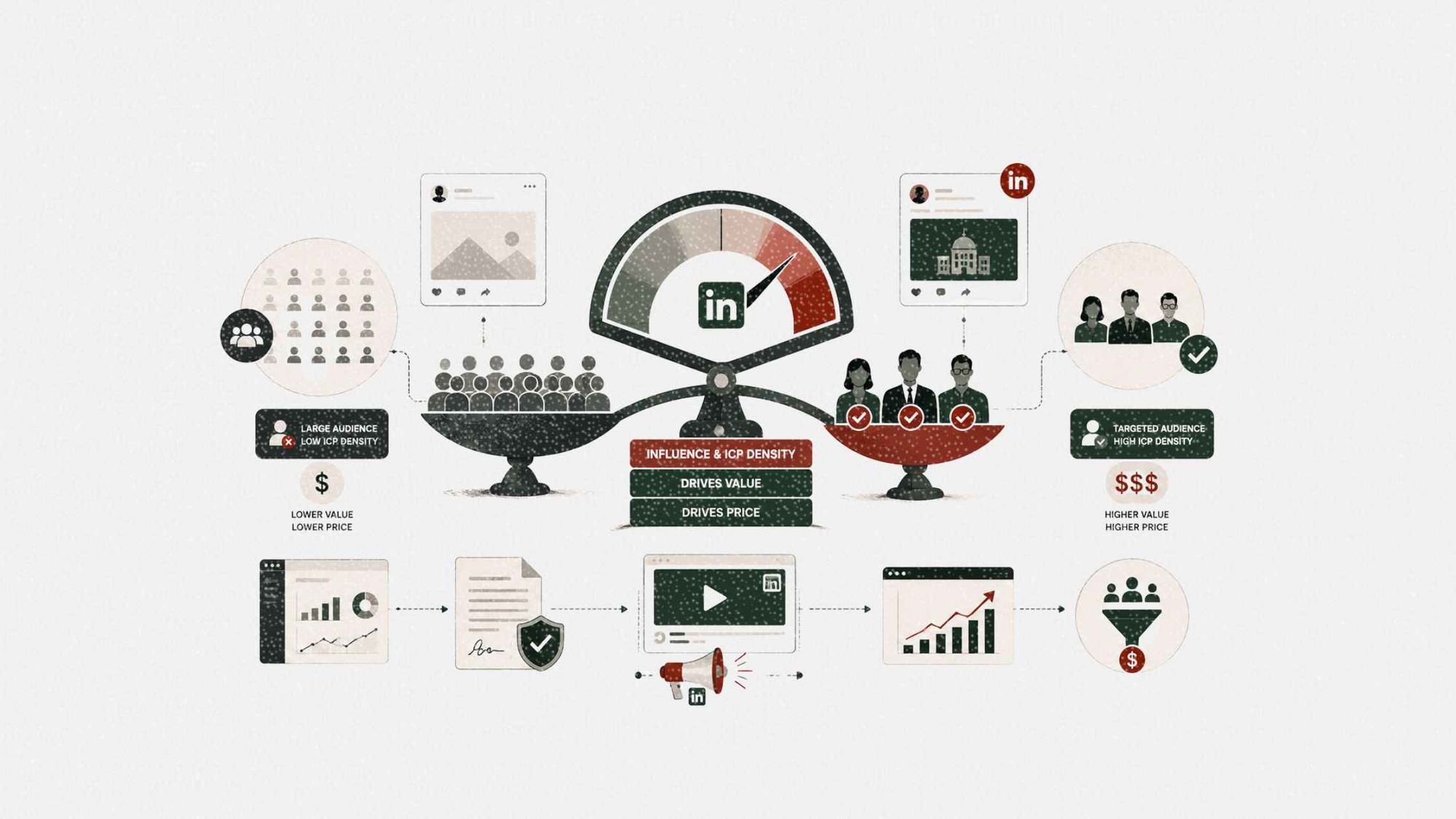
LinkedIn creator rates do not follow the pricing logic every marketer learns from Instagram. The usual formula of follower count multiplied by a platform multiplier falls apart on LinkedIn because the variable that drives value is not reach. It is audience composition.
A creator with 12,000 followers where 40% hold VP or C-suite titles at mid-market SaaS companies is worth categorically more to a B2B brand than a lifestyle creator with 200,000 Instagram followers whose audience includes no one in your buying committee.
Before diving into the numbers, it helps to understand why LinkedIn is a pricing outlier to begin with.
 Ariana Sorensen
Table of contents
Jump to each section:
- Why LinkedIn creator pricing works differently from other platforms
- LinkedIn influencer rates by tier: what brands are paying in 2026
- Content format premiums: posts, carousels, video, and Thought Leader Ads
- What drives the B2B pricing premium on LinkedIn
- Add-ons that move the total cost: usage rights, exclusivity, and whitelisting
- How to evaluate whether a LinkedIn creator rate is justified
- Building your LinkedIn creator budget in 2026
Why LinkedIn creator pricing works differently from other platforms
On Instagram and TikTok, follower count is a rough but usable proxy for pricing. The variable you are buying is reach: how many people will see the post. LinkedIn breaks that model for one reason. Professional identity is visible and verifiable at the point of creator selection in a way it is not on any consumer platform.
Before you sign a contract, you can see what percentage of a creator's audience holds Director-level titles or above, which industries they work in, and what size of company employs them. That transparency changes the commercial logic entirely.
A B2B brand selling enterprise security software does not need 500,000 impressions. It needs 5,000 impressions from CISOs and heads of IT at companies with the procurement budget to evaluate an enterprise deal. A LinkedIn creator with 18,000 followers concentrated in that audience segment can deliver something no consumer platform creator can offer at any follower count: verified ICP density.
The practical effect on pricing is that LinkedIn creator rates converge around audience quality rather than audience size. Follower count gives you a starting range, but the final number is heavily influenced by how senior the audience is, how relevant the creator's niche is to your buyers, and what percentage of that audience matches your ICP.
LinkedIn influencer rates by tier: what brands are paying in 2026
Favikon's analysis of 136 LinkedIn influencers, covering follower counts from 200 to 700,000, found that approximately 81% of LinkedIn creator posts are priced between US$200 and US$2,000 per post, with the full range running from as low as US$10 to a high of US$7,500.
That broad distribution reflects the wide spread in audience quality across the platform. A career-content creator with 50,000 followers who posts motivational content for job seekers and a niche cybersecurity practitioner with 15,000 followers whose audience is exclusively enterprise security buyers both fall somewhere in that US$200 to US$2,000 band, but they are not interchangeable for a B2B campaign.
For B2B SaaS campaigns targeting VP, Director, and C-suite decision-makers specifically, the relevant pricing range sits higher. InfluenceFlow's 2026 pricing analysis puts B2B LinkedIn thought leader rates at US$2,000 to US$15,000 per post, with video content and highly senior audiences at the upper end of that range.
Here is how the rate structure looks across tiers in the B2B context in 2026:
Nano LinkedIn creators (under 10,000 followers) run US$200 to US$800 per post for general professional audiences, and US$500 to US$2,500 for niche B2B verticals where the audience is concentrated in a specific buyer role. This tier is often the most cost-efficient for hyper-targeted ABM campaigns where reach is less important than audience fit.
Micro LinkedIn creators (10,000 to 100,000 followers) run US$500 to US$5,000 per post depending on niche. Practitioners writing about SaaS operations, RevOps, or enterprise procurement sit at the higher end. Ahrefs' influencer marketer Igor Gorbenko has publicly noted that most LinkedIn creators they sponsor in the marketing niche charge between US$500 and US$2,000 per post, which aligns with Favikon's data for the core of this tier.
Macro LinkedIn creators (100,000 to 500,000 followers) run US$5,000 to US$20,000 per post. Rates at this tier reflect the combination of reach and authority, though campaign control and approval cycles become longer. Most analysts, conference keynote speakers, and widely-read industry authors sit here.
Top-tier LinkedIn voices (500,000+ followers) typically command US$15,000 to US$50,000+ per post or campaign package. At this scale, brands are buying category association alongside reach, which explains rates that bear no relationship to the follower-count formula used on consumer platforms.
The rate convergence around audience role-match is important to understand. Influencer Advisory's 2026 deal log analysis across 37 priced LinkedIn partnerships showed rates converging to a US$500 to US$5,000 band per post regardless of follower count when the brief was B2B-oriented, because what the brand was purchasing in each case was access to a specific type of decision-maker, not a specific reach number.
Content format premiums: posts, carousels, video, and Thought Leader Ads
Format significantly affects what you pay, both in creator fees and in the amplification costs that follow. Here is how the major LinkedIn content formats price out in 2026:
Text posts and native text with links carry the base rate for any creator tier. Shorter production time, no design cost, this is where Favikon's core data applies most cleanly.
Carousel posts are typically priced at 20 to 35% above a comparable text post for the same creator. Production involves design work (either the creator's own or outsourced), and carousels consistently outperform text posts on dwell time and saves. For B2B brands, carousels work well as thought leadership formats because the multi-slide structure allows for more substantive arguments.
Video posts carry a 40 to 80% premium over a creator's base text rate, reflecting scripting, filming, and editing time. LinkedIn video uploads grew 34% year over year per LinkedIn's own 2025 data. For B2B brands, video is particularly effective for product context and demo-adjacent content.
Thought Leader Ads (TLA) amplification is where the pricing discussion shifts from creator fees to paid media. When you amplify a creator's organic LinkedIn post as a Thought Leader Ad, the platform CPM for B2B targeting in North America and Western Europe runs US$55 to US$110 for broad B2B audiences, reaching US$150 to US$300 for ultra-narrow ICP targeting (C-suite at specific company sizes), according to benchmark data from The Smarketers' Q1 2026 analysis.
The performance advantage justifies that media cost. ZenABM's 2026 LinkedIn ABM Performance Benchmarks Report, which analyzed 161,256 ads across 211 B2B companies and US$5.5M in spend, found Thought Leader Ads delivered a median CTR of 2.68% against 0.44% for single-image ads, roughly 6x higher click-through. Fractional Demand's 15-month analysis of US$3.5M in LinkedIn spend put the TLA CPC advantage even higher: US$0.51 per click against US$2.42 for standard ad formats.
For APAC-based campaigns, LinkedIn CPMs run 30 to 60% lower than North American benchmarks, according to The Smarketers' regional breakdown. That makes LinkedIn creator programs in markets like Singapore, Indonesia, and Australia more cost-efficient to amplify, though creator base rates in those markets are also different from US pricing.
What drives the B2B pricing premium on LinkedIn
The B2B pricing premium on LinkedIn comes from four structural factors that do not exist at the same intensity on consumer platforms.
Audience purchasing authority is the first driver. A LinkedIn creator's followers include active professionals with budget authority. When the creator's audience is concentrated in roles that typically carry procurement decisions (VP of Engineering, Head of Marketing, COO at Series B companies), the commercial value of a post endorsement scales beyond what impression volume can capture.
Platform content lifespan is the second. LinkedIn posts have a longer organic distribution window than Instagram or TikTok content. A high-performing LinkedIn post can continue to generate engagement and reach for five to seven days, sometimes longer. Usage rights for B2B repurposing (Thought Leader Ads, gated content embeds) extend that commercial window further, which is why brands negotiate longer license periods for LinkedIn content than for Stories or short-form video.
Review cycle costs also factor in. B2B LinkedIn creator partnerships typically involve legal and product marketing review before posts go live. Creators price the time spent in that review process into their rates. A creator who produces a single Instagram post with one round of comments charges differently from one who runs three revision cycles on a LinkedIn article co-developed with your product team.
Niche scarcity rounds out the picture. The number of genuinely credible LinkedIn creators in narrow B2B verticals (cybersecurity, supply chain, enterprise fintech, regulated industries) is small relative to demand. Scarcity pricing applies when the brief requires a creator whose audience cannot be approximated by a general professional content account.
Dinda Anandita, Account Director at Content Collision, content-led PR agency Content Collision, notes: "On LinkedIn, you are not just paying for a post. You are paying for the trust that creator has built with a specific professional community, and that trust has a compounding value for B2B brands that most rate cards fail to capture. When we evaluate whether a LinkedIn creator rate makes sense for a client, the first question is always what percentage of that creator's audience your sales team would actually want a meeting with. If the answer is 30% or above, the rate almost always makes sense."
Add-ons that move the total cost: usage rights, exclusivity, and whitelisting
The base posting fee is one component of the total LinkedIn creator cost. Several add-ons routinely push the final number significantly higher, and B2B campaigns are especially likely to trigger them.
Content usage rights are the license to republish a creator's post, video, or carousel in your own channels beyond the organic post. B2B-specific uses such as embedding a creator's quote in a gated whitepaper, repurposing a LinkedIn article in an ABM email sequence, or using a creator's video clip in a webinar each require explicit contractual language.
Thought Leader Ad access grants a brand permission to amplify a creator's organic post as a LinkedIn Thought Leader Ad and typically costs 20 to 40% above the organic post fee. Some creators negotiate this as a flat add-on per campaign; others roll it into the base rate for partnerships that assume amplification.
Exclusivity clauses prevent the creator from working with direct competitors for a defined period. Standard exclusivity clauses in B2B LinkedIn partnerships add 25 to 50% to the base rate depending on the category, the duration, and how narrowly competitors are defined. In specialized verticals like enterprise HR tech or B2B cybersecurity, exclusivity carries a higher premium because the creator pool is small.
Long-form article or newsletter co-authorship requires more production time than posts. Co-authorship arrangements, where the brand provides research and the creator provides voice and distribution, typically price at 1.5 to 2x the standard post rate for the same creator.
 Ariana Sorensen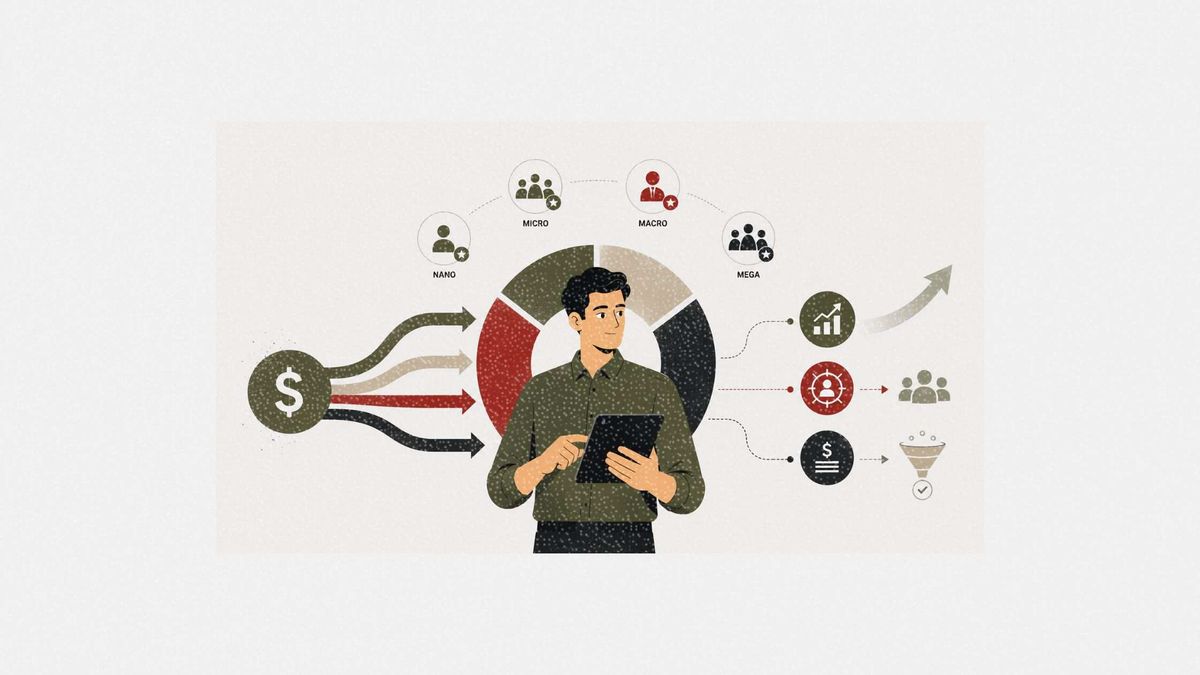
How to evaluate whether a LinkedIn creator rate is justified
Follower count is an initial filter for LinkedIn creator selection, not a valuation tool. Once you move past discovery, these are the metrics that should drive your rate evaluation.
Audience composition match is the starting point. Use Favikon, Modash, or LinkedIn's own Creator Analytics (where accessible) to pull the percentage of the creator's audience that holds titles and works at companies matching your ICP. A creator whose audience is 35% Director or above at companies in your target segment is worth more than one with twice the follower count but a junior or unverifiable audience mix.
Engagement rate benchmarked against the platform median matters next. SociaVault's 2026 benchmark study of 40,000+ LinkedIn profiles found that micro-level creators with 10,000 to 50,000 connections achieve a median engagement rate of 3.83%, above the platform overall median of 2.94%. Any creator quoting a premium rate should be clearing the platform median at minimum. A creator with a 1% engagement rate on a professional audience is charging you for followers who have effectively disengaged.
A comment quality audit rounds out the evaluation. LinkedIn comments from VP-level practitioners are qualitatively different from generic reaction comments. A quick manual review of 10 to 15 recent posts tells you whether the engagement is substantive professional discussion or low-signal reactions. If the comment thread reads like a professional community discussing a real problem, the rate has a better foundation.
Attribution potential should also be confirmed before finalizing any rate. Check whether the creator supports UTM-tracked links in posts, and whether their content format (text versus article versus video) is compatible with your attribution methodology.
A creator who cannot or will not include trackable links in sponsored content creates a measurement gap that makes post-campaign reporting difficult. For B2B programs where the attribution window runs 60 to 90 days minimum, confirmed UTM compliance is a pre-contract requirement, not a post-launch assumption.
Building your LinkedIn creator budget in 2026
For B2B brands building a LinkedIn creator program from scratch, the pricing data above translates into a few practical budget anchors for 2026.
A foundational program working with three to five micro-tier LinkedIn creators (10,000 to 100,000 followers, B2B niche) across a quarter should plan for US$1,500 to US$15,000 in total creator fees, depending on niche, format mix, and usage rights. Add 20 to 40% for Thought Leader Ad amplification if the strategy includes paid distribution.
A mid-scale program running eight to twelve creators, including one or two macro-tier voices for category authority, should budget US$15,000 to US$60,000 in creator fees per quarter before amplification. Usage rights, exclusivity, and long-form content add-ons can push quarterly costs above US$80,000 at this scale.
Brands entering LinkedIn creator marketing for the first time should resist the instinct to concentrate spend on one or two high-follower-count creators. The pricing data from the Influencer Advisory deal log consistently shows that three to four micro-tier creators with high ICP density outperform a single macro-tier voice on pipeline-relevant metrics, and at lower combined cost.
 Ariana Sorensen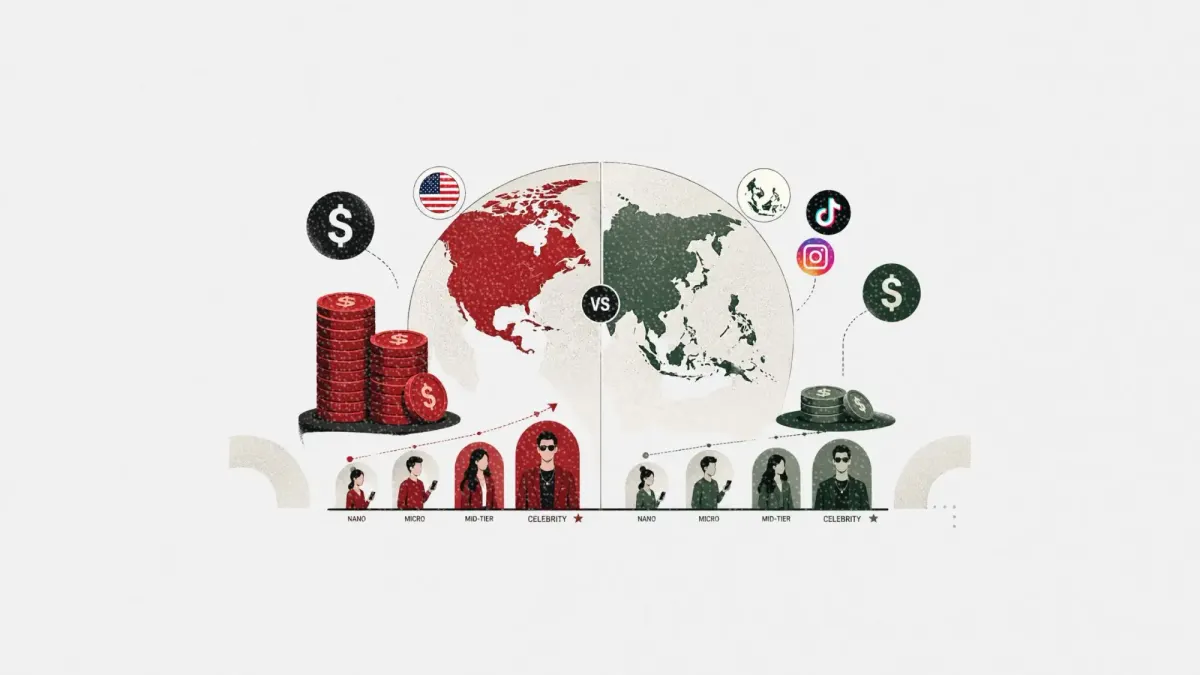
The single most consistent finding across 2025 to 2026 LinkedIn creator pricing data is that the brands overpaying for LinkedIn are the ones evaluating creators by follower count rather than by audience role composition. The brands getting strong returns are the ones who negotiate rates against verified ICP density, build usage rights into the original contract, and measure success at 90-day attribution windows rather than 30-day dashboards.