LinkedIn influencer marketing: a complete playbook for B2B brands
Why your LinkedIn influencer strategy is probably built on the wrong assumptions

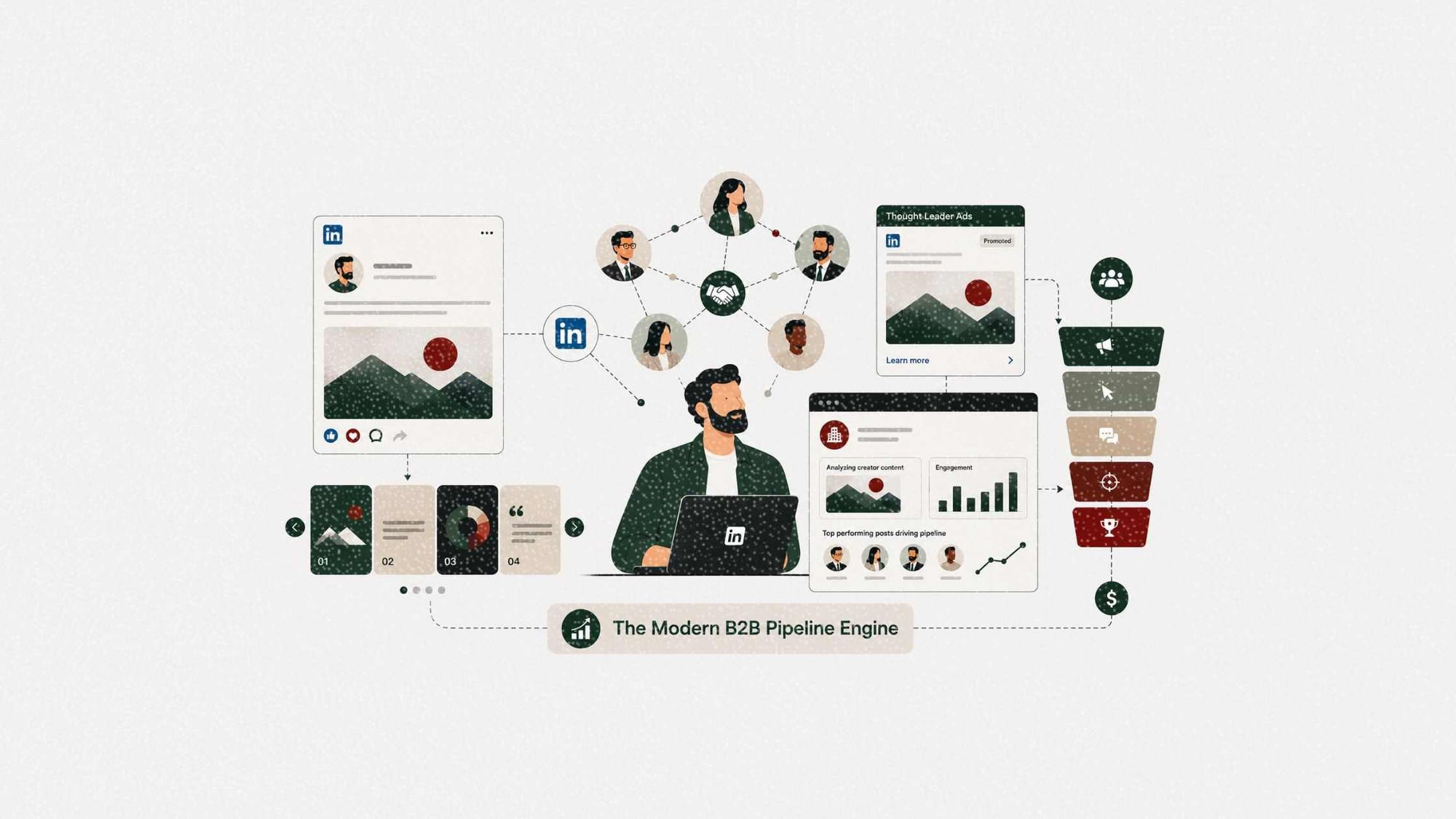
LinkedIn is no longer a passive job board or a place to share company news. It is the primary arena where B2B buying decisions get shaped, and creator content is increasingly at the center of that process.
The numbers bear this out. According to the LinkedIn and Ipsos 2025 B2B Marketing Benchmark: The Influence Report, 55% of B2B marketers already use influencer or creator marketing on LinkedIn, with another 29% planning to adopt it within the next year. Brands running influencer programs on the platform outperform those that do not by up to 39% on customer engagement and brand awareness, and by 30% on revenue growth and lead generation.
If you are a B2B brand that is still treating LinkedIn as a broadcast channel for company announcements, this playbook will show you what you are missing and how to close that gap.
Table of contents
Jump to each section:
- Why LinkedIn is the B2B influencer platform
- The operator-creator: LinkedIn's emerging B2B influencer tier
- Types of B2B LinkedIn influencers and which to work with
- How to find the right LinkedIn influencers for your brand
- Content formats that perform for B2B brands on LinkedIn
- LinkedIn Thought Leader Ads: the paid amplification playbook
- How to measure LinkedIn influencer ROI
- Building an always-on LinkedIn influencer program
- Where most B2B brands go wrong on LinkedIn
Why LinkedIn is the B2B influencer platform
No other platform concentrates decision-maker attention the way LinkedIn does. The platform now has over 1.3 billion registered members globally, and four out of five of those members drive business decisions at their organizations, according to LinkedIn Marketing Solutions. In February 2026 alone, the platform received over 1.8 billion visits at an average session duration of more than seven minutes, according to Foundation Marketing's analysis of SimilarWeb data. Your buyers are not just present. They are engaged.
The platform also drives a disproportionate share of B2B leads from social media, accounting for 75 to 85% of all B2B social leads, according to ConnectSafely's 2026 LinkedIn statistics analysis. Other social platforms can supplement, but LinkedIn is where B2B pipeline actually originates.
Creator content is now a significant part of what moves those decisions. The LinkedIn and Ipsos 2025 Influence Report found that expert endorsements are 1.7 times more likely to give a brand the edge over a rival compared to written content from the company itself.
Being named the top solution by analysts or industry experts was ranked as the single most influential trust signal by 37.9% of B2B buyers surveyed, ahead of both video and written customer testimonials.
The conclusion for B2B marketers is not subtle: on LinkedIn, an expert voice outperforms a brand voice. That is the commercial logic behind LinkedIn influencer marketing.
The operator-creator: LinkedIn's emerging B2B influencer tier
Most conversations about influencer marketing assume a five-tier taxonomy: nano, micro, macro, mega, and celebrity. LinkedIn requires a sixth tier, one that existing frameworks consistently miss.
The operator-creator is a working B2B practitioner, typically a founder, VP, or senior individual contributor, who documents their professional thinking publicly on LinkedIn. They are not full-time content creators. They have a day job that gives them credibility. Their audiences are small by consumer standards, often between 5,000 and 50,000 followers, but those audiences are dense with the exact buyers B2B brands want to reach.
A SaaS founder with 12,000 LinkedIn followers who posts weekly about growth, tooling, and revenue operations is not comparable to a lifestyle macro-influencer with 500,000 Instagram followers. The former reaches a buying committee. The latter reaches a general audience. The ICP density advantage of the operator-creator is what makes LinkedIn influencer economics so different from every other platform.
Dinda Anandita, Account Director at Content Collision, describes the shift she sees in how B2B brands are approaching LinkedIn creators: "The most effective LinkedIn influencer programs we see are not brands chasing follower counts. They are finding practitioners who already have the trust of the exact buying committee they want to reach, and then giving those practitioners the space to speak in their own voice. The moment you over-script a LinkedIn creator, you lose the thing that made them valuable in the first place."
Types of B2B LinkedIn influencers and which to work with
B2B LinkedIn influencers broadly fall into four categories, each with a different use case in a campaign.
Industry analysts and category experts are the highest-trust tier. Think Gartner analysts, Forrester researchers, and independent category experts who publish frameworks that practitioners cite. The LinkedIn and Ipsos 2025 Influence Report found that thought leaders and industry analysts are rated the most effective influencer type by 28% of B2B marketers. They are expensive and slow to activate, but their endorsements carry the most weight at the bottom of the funnel, particularly when a buying committee is doing final vendor evaluation.
Customer influencers are existing buyers who happen to have built a LinkedIn following while talking about their professional work. Because they are already customers, their advocacy is inherently credible and easier to activate through community programs, co-marketing, or advisory arrangements. The LinkedIn and Ipsos 2025 Influence Report rated company customers as the second most effective influencer type, cited by 23% of marketers.
Independent creators and practitioners are the operator-creator tier described above. They are not analysts and they are not your customers, but they have earned an audience by consistently sharing useful professional thinking. For most B2B brands, this is the most cost-efficient tier for sustainable influencer programming.
Internal executives are employees, including founders and C-suite leaders, who are activated as creator voices. While technically inside the organization, their LinkedIn presence functions as influencer content when boosted and distributed. This tier overlaps directly with Thought Leader Ads, covered later in this playbook.
The TopRank Marketing 2025 B2B Influencer Marketing Report found that the top challenge for B2B marketers remains finding the right influencers, cited by 48% of respondents. The problem is not that there are not enough LinkedIn creators. The problem is that most discovery processes rely on follower count as a proxy for fit, which fails completely on a platform where a 15,000-follower operator-creator can outperform a 300,000-follower general business voice on every metric that matters for B2B.
How to find the right LinkedIn influencers for your brand
The selection criteria shift significantly when you move from consumer to B2B contexts. The LinkedIn and Ipsos 2025 Influence Report found that authenticity and credibility are the top selection criteria for 58% of B2B marketers, followed by industry relevance at 49%, brand alignment at 47%, and subject matter expertise at 47%. Follower count did not make the top four.
With those criteria in mind, here are five discovery methods that work for B2B LinkedIn programs.
LinkedIn's own advanced search allows you to filter by job title, company, industry, and geography. Using Boolean search strings, you can find practitioners who match your ICP's profile and then evaluate their content manually for consistency and resonance.
LinkedIn Sales Navigator extends this considerably. Its creator filters let you identify individuals with large followings in specific industries, seniority levels, and company types. For brands with a defined ICP, Sales Navigator is the most direct path to building a qualified influencer shortlist.
Specialized B2B influencer databases such as Favikon have built LinkedIn-specific indexes that go beyond basic follower metrics to include engagement rates, content themes, and audience composition at the industry and seniority level. For B2B programs focused on LinkedIn, this is significantly more useful than general influencer platforms that treat LinkedIn as an afterthought.
Content mining through your own network is frequently underused. Your existing customers, community members, and newsletter subscribers include people who post on LinkedIn regularly. Identifying buyers in your network who have active creator presences can produce a warm influencer pipeline with built-in brand alignment.
Substack and newsletter crossovers are worth attention. Many LinkedIn operator-creators also run newsletters, and the audience overlap tends to be high. Finding an operator-creator whose newsletter reaches your ICP and then activating them on LinkedIn gives you cross-channel distribution that a LinkedIn-only strategy misses.
For a closer look at the AI tools that accelerate each of these discovery methods, see our comparison of the best AI influencer marketing tools.
Content formats that perform for B2B brands on LinkedIn
Not all LinkedIn content performs equally, and the format data is striking enough to shape how you brief creators.
Carousel posts, which display as swipeable PDF documents in the feed, achieve the highest average engagement rate on the platform at 6.60%, according to ConnectSafely's 2026 LinkedIn statistics analysis. That figure is 278% higher than video, 303% higher than images, and 596% higher than text-only posts.
For B2B influencer campaigns, this means frameworks, checklists, case breakdowns, and comparison guides packaged as carousels consistently outperform more polished video production.
Video is growing fast regardless. LinkedIn recorded 34% year-over-year growth in video uploads in 2025, according to LinkedIn's own platform data. Short-form video between 7 and 15 seconds is emerging as a distinct high-performing format within the feed, with LinkedIn Live events generating three times longer average viewing times compared to on-demand content.
Text posts remain the most accessible format for operator-creators and, when written with a strong hook, a concrete data point, and a genuine point of view, regularly outperform more produced content. The authentic, unpolished nature of text posts is part of what makes them work on a platform where buyers are trained to filter out promotional signals.
For B2B influencer programs, the practical brief is to let creators work in their native format. Forcing a primarily text-based operator-creator to produce polished video will typically underperform their standard output. Match the format to the creator's established content pattern, not to what your brand's design team prefers.
LinkedIn Thought Leader Ads: the paid amplification playbook
Thought Leader Ads are LinkedIn's ad format that lets companies sponsor organic posts from individual employee or external creator profiles, rather than from company pages. The post appears in the feed with the individual's face, name, and personal profile, with a small "promoted" label. It looks like native content because it is native content, just with paid distribution.
The performance gap over standard company page ads is documented at the platform level. LinkedIn's own data shows Thought Leader Ads deliver 1.6 times higher engagement and 1.7 times higher click-through rates than standard single-image ads, according to multiple practitioner analyses citing LinkedIn's campaign manager data. Independent agencies report cost-per-lead reductions of 30 to 40% compared to traditional sponsored content when running the same message through a personal profile versus a company page.
The performance advantage traces back to a straightforward trust dynamic. A post from a VP of engineering explaining a specific technical challenge carries inherent professional credibility that the same message published under a company logo cannot replicate. B2B buyers engage differently when they believe a person, not a brand, is speaking.
Setup requires the creator or employee to have creator mode activated on their LinkedIn profile and the post to be fewer than 30 days old. For external influencers, this requires a formal agreement that grants your brand permission to sponsor their posts. The most effective Thought Leader Ad sequences follow a three-stage logic.
The first stage amplifies a high-value insight post with no conversion CTA, building authority and creating a retargeting audience from people who engage.
The second stage serves that retargeting audience with a proof-based post, typically a case study or data point, from the same creator.
The third stage introduces a direct conversion CTA, a demo, a lead form, or a content download, to an audience that has already self-selected as interested. Running conversion CTAs to cold audiences before this sequence is the most common cause of poor Thought Leader Ad performance.
For a detailed breakdown of how to structure the influencer brief before activating Thought Leader Ads, see our guide to influencer brief templates for B2B.
How to measure LinkedIn influencer ROI
LinkedIn influencer programs that do not define measurement in advance typically default to vanity metrics, reach, impressions, and follower gains, none of which connect to pipeline.
The metrics that map to commercial outcomes for B2B LinkedIn programs fall into three categories.
Awareness and trust signals include post reach, impressions, and the engagement rate on influencer content versus benchmark brand content. The LinkedIn and Ipsos 2025 Influence Report found that 76% of marketing leaders believe collaborating with creators builds brand authenticity, but authenticity only becomes commercially useful when it is tracked through to pipeline influence.
Consideration-stage signals include profile visits generated from influencer content, LinkedIn follower growth among ICP-matched accounts, content download rates when a gated asset is featured, and email sign-up conversions from creator-promoted landing pages.
Pipeline signals are where B2B measurement needs to go further than it typically does. UTM tracking on all creator-linked URLs allows first-touch attribution into your CRM. For longer sales cycles, this means tagging the company account as influenced by creator content in Salesforce or HubSpot, even when the final conversion happens weeks or months later. Multi-touch attribution models that credit LinkedIn influencer touchpoints alongside paid search and direct traffic produce a more accurate picture of program value.
The TopRank Marketing 2025 B2B Influencer Marketing Report found that the most advanced B2B influencer programs are twice as likely to track ROI in terms of MQLs, SQLs, and share of voice, compared to less mature programs that track impressions only.
Building an always-on LinkedIn influencer program
The single most predictive variable for B2B LinkedIn influencer program success is not budget. It is consistency. The TopRank Marketing 2025 B2B Influencer Marketing Report found that 99% of B2B marketers using an always-on influencer approach rate their programs as effective. Always-on means ongoing creator relationships, not quarterly campaign activations.
The structural difference matters because B2B buying cycles are long. A prospect who sees a LinkedIn creator mention your product in January may not initiate a sales conversation until September.
Campaign-based influencer programs with discrete start and end dates systematically under-attribute value because they capture only the buyers who are already near purchase when the campaign runs. Always-on programs compound across the full buying cycle. Building an always-on LinkedIn program has three practical requirements.
First, a stable roster of three to eight creators whose ICP alignment you have validated. Programs with fewer than three creators are too dependent on any single voice. Programs with more than eight are typically beyond the relationship management capacity of a team without dedicated influencer staffing.
Second, a content calendar that allocates creator posting cadence rather than individual posts. You are not briefing individual pieces of content. You are maintaining a rhythm of creator touchpoints across the buying cycle, with quarterly themes that align to your product roadmap or market narrative.
Third, a relationship investment that goes beyond transactional payments. The most effective B2B LinkedIn influencer programs involve creators in product feedback, early access programs, and joint event appearances, not just paid post slots. This structural investment is what produces the authentic advocacy that differentiates a program from a paid media placement.
The 72% of the most advanced B2B influencer teams who report having a dedicated influencer budget that is expected to grow, according to the TopRank Marketing 2025 report, are the teams building this way.
Where most B2B brands go wrong on LinkedIn
The mistakes that derail B2B LinkedIn influencer programs are predictable enough that they are worth naming directly before you launch.
Over-scripting is the most common failure mode. When a brand provides a creator with a fully written post, the creator's audience recognizes it immediately. The authentic professional voice that earned the audience disappears and with it the credibility that made the creator valuable. A well-structured brief should define the key message, the data point or claim to include for accuracy, and the desired outcome, without dictating how the creator says it.
Selecting creators by follower count rather than audience composition. A LinkedIn creator with 8,000 followers in your exact target segment outperforms one with 80,000 general business followers on every B2B metric. Follower count is the wrong input variable for platform where ICP density matters more than raw reach.
Running one-off campaigns without building toward always-on. A single sponsored LinkedIn post produces a data point, not a program. Brands that treat LinkedIn influencer marketing as a campaign tactic rather than a sustained relationship strategy consistently underestimate the returns.
Skipping the paid amplification layer. Organic LinkedIn reach has been declining, meaning even strong creator content reaches a fraction of the creator's own network. Thought Leader Ads are not optional for serious programs. They are the mechanism that makes organic content reach its potential audience consistently.
Measuring only outputs rather than outcomes. Impressions, reach, and likes are easy to report but difficult to defend in a budget conversation. Programs that do not connect creator activity to pipeline from the outset are the programs that get cut when budgets tighten.
For a deeper look at how to build measurement into your program from day one, see our guide to influencer marketing ROI for B2B marketers.
Start with a creator, not a campaign
LinkedIn influencer marketing does not begin with a campaign brief. It begins with finding a practitioner whose audience already trusts them on the topics you need to be known for, and then building a relationship long enough to produce content that earns the same trust for your brand.
The platform is ready. The data is clear on what works. The remaining variable is the discipline to build for the long buying cycle rather than the short reporting period.