Media advisory: how PR teams get journalists to show up
A practical media advisory guide for PR teams, covering format, examples, media advisory vs press release, outreach timing, and measurement.

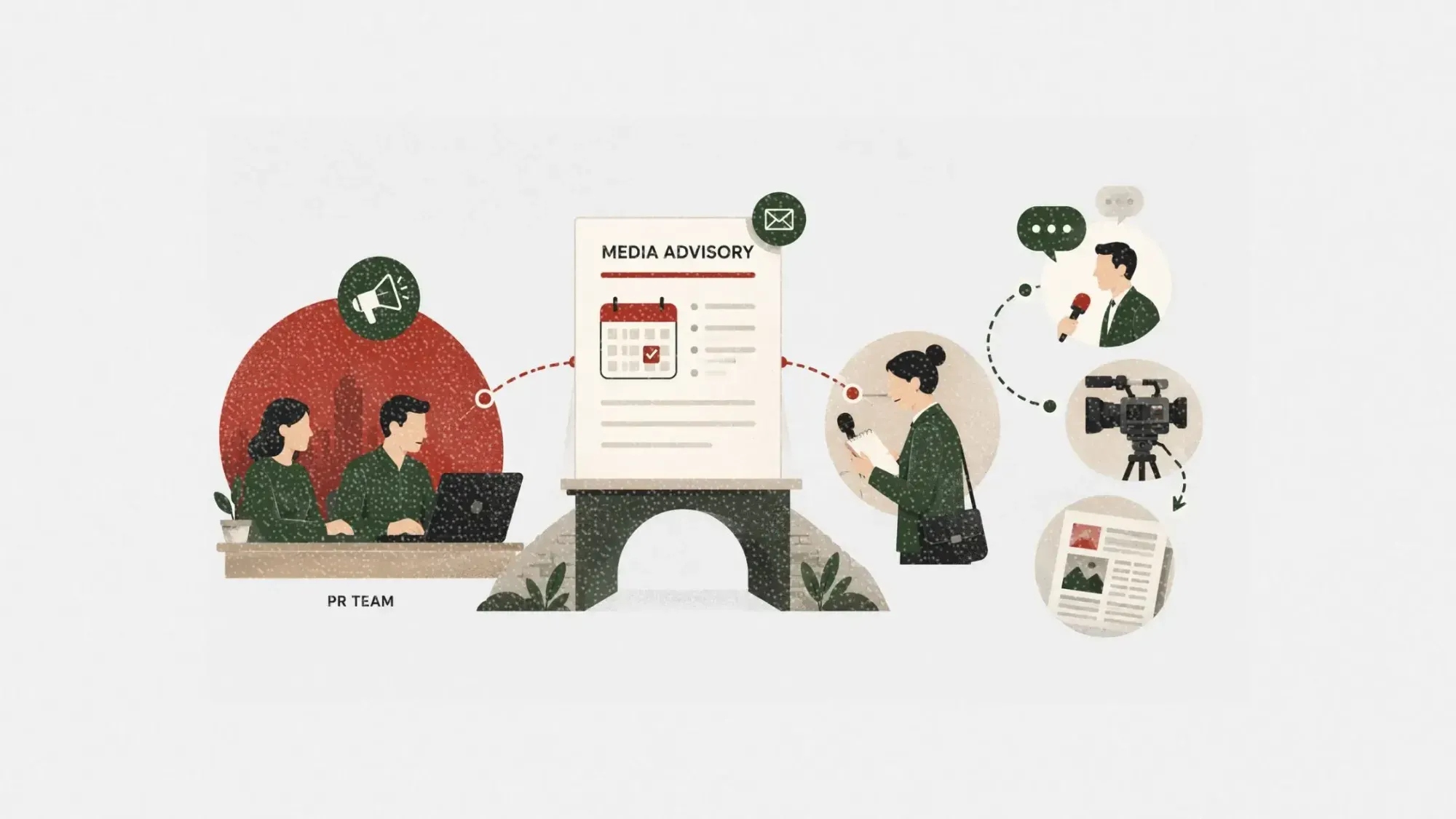
A media advisory is one of the simplest PR assets to write badly. It looks short, so teams treat it like a calendar notice, a mini press release, or a last-minute email blast. The result is usually the same: journalists cannot quickly tell why the event matters, whether it is worth attending, or what they will get if they show up.
For B2B marketers, founders, and PR teams, the stakes are higher than a single event. A strong advisory helps reporters plan coverage, prepare questions, assign a camera crew, request an interview, or decide whether the event deserves a follow-up story. In an AI-search era, it also creates a clean public record of who was involved, what happened, and why the moment mattered.
Table of contents
Jump to each section:
- What a media advisory is
- Media advisory vs press release
- When a media advisory is the right format
- What to include in a media advisory
- How to write a media advisory journalists can use
- A practical media advisory template
- Real media advisory examples worth studying
- Tools that make advisory workflow easier
- How to send and follow up without annoying reporters
- How to measure whether the advisory worked
What a media advisory is
A media advisory is a short notice that invites journalists to cover an upcoming event, interview opportunity, announcement, briefing, demo, or public appearance. Its job is not to tell the whole story. Its job is to help a reporter or assignment editor decide whether the moment is worth covering.
PR Newswire describes a media advisory as a brief notice, also called a media alert or press advisory, that gives reporters the essential details they need to decide whether to attend an event. That distinction matters because journalists are not reading the advisory for brand background. They are scanning for news value, timing, location, access, and visuals.
In practice, a media advisory usually fits on one page. It should answer the five Ws, name the available spokespeople, explain what visuals or interview opportunities exist, and make it easy for the reporter to RSVP or ask a fast question.
Think of it as a coverage invitation with editorial context. It should be useful enough for the reporter to act on, but restrained enough that it does not become a bloated announcement.
 Patrecia Meliana
Media advisory vs press release
The simplest difference is this: a press release tells the story, while a media advisory invites coverage of the story.
A press release works when the news can stand on its own. It includes the announcement, quotes, context, proof points, boilerplate, and often enough detail for a journalist to write without attending anything. A media advisory works when the coverage opportunity is tied to a moment: a press conference, product demo, roundtable, launch event, funding briefing, executive appearance, policy announcement, or community activation.
According to PR Newswire, press releases usually provide a complete story with quotes and supporting details, while media advisories stick to the essential facts about an upcoming event. That means the advisory should be shorter, more logistical, and more selective.
Use a press release when:
- The news is already complete and can be reported from the written asset.
- You need a public record that customers, investors, partners, and search systems can find.
- The story benefits from quotes, data, background, and a company boilerplate.
Use a media advisory when:
- You want journalists to attend, photograph, record, or interview someone.
- The value of the story depends on seeing the moment live or speaking to people on site.
- You need to brief assignment editors, local reporters, industry journalists, or event producers quickly.
Many campaigns need both. You might send an advisory before the event, then publish a release afterward with the actual announcement, quotes, images, and outcomes.
When a media advisory is the right format
A media advisory is strongest when there is a real-time element that journalists can cover better by attending or scheduling direct access.
Good use cases include:
- A press conference with executives, partners, customers, or public officials.
- A funding, expansion, or product launch event with a live demo.
- A data briefing where reporters can ask questions before the report goes public.
- A trade show appearance with a spokesperson available for interviews.
- A community event, ribbon cutting, award ceremony, or public activation with strong visuals.
- A crisis or issue briefing where the organization needs to give reporters access to decision-makers.
The format is weaker when the event has no clear news value. A webinar, office party, generic panel, or sales demo does not automatically deserve an advisory. The reader should be able to answer one question immediately: what can a journalist get here that they cannot get from a normal email?
For B2B teams, that might be access to a founder after a funding announcement, a customer willing to speak on the record, a product walkthrough with technical leads, or embargoed data that changes how a market is understood.
What to include in a media advisory
A useful media advisory is built around logistics, access, and the editorial hook. The National Association for the Education of Young Children says an advisory should make the event sound interesting and newsworthy while making the details easy for reporters to pick up quickly.
The core elements are:
- Headline: A clear line that names the event and why it matters.
- Short lead: Two or three sentences explaining the news value.
- What: The event, briefing, demo, announcement, or media opportunity.
- Who: Speakers, spokespeople, partners, customers, officials, or experts available.
- When: Date, start time, end time, and time zone.
- Where: Full address, room, virtual link, check-in instructions, or broadcast access.
- Why it matters: The audience relevance, not the brand's internal reason for caring.
- Photo or interview opportunity: What reporters can capture or who they can speak with.
- RSVP and contact: A named person with email, phone, and deadline if needed.
- Background note: One short paragraph for context, not a full company history.
The NAEYC media advisory template also shows why basic formatting still matters: the template separates what, who, when, and where so a reporter can scan the asset quickly.
That structure is not old-fashioned. It is considerate. Assignment editors are often deciding coverage under time pressure. A clean advisory reduces the work required to say yes.
How to write a media advisory journalists can use
Start with the journalist's decision, not your internal announcement plan. A reporter is asking: is this relevant to my beat, can I access the right person, is there a visual or quote opportunity, and can I make the timing work?
Your headline should answer the beat relevance question. Avoid brand-first phrasing like "Company X announces exciting event." Use the event's news value instead: "Cybersecurity startup to brief reporters on new fraud data ahead of holiday shopping season."
Then write a short lead that explains why the moment matters now. If the event is tied to new data, a regulatory change, a market trend, a local impact, or a notable spokesperson, say that early. Do not bury the reason in paragraph four.
Tommy Prayoga, Head of Agency at digital PR service provider Content Collision: "A good media advisory respects the reporter's planning problem. It should make the assignment decision easier by showing the story, the access, and the timing in under a minute. If the team needs five paragraphs to explain why the event matters, the event probably needs a sharper angle before it needs outreach."
The highest-performing advisory is rarely the most elegant one. It is the one that makes the coverage opportunity obvious.
Before sending, ask five hard questions:
- Would a reporter understand the story without joining an internal brand meeting?
- Is the most newsworthy detail in the first three lines?
- Have we named the people available for interviews?
- Have we explained what can be photographed, recorded, or quoted?
- Can someone attend without emailing three follow-up questions about logistics?
If the answer to any of those is no, rewrite before distribution.
A practical media advisory template
Use this as a working structure, then adapt it to your event, beat, and media list.
Subject line: Media advisory: [clear event hook] on [date]
Headline: [Newsworthy event or access opportunity]
Lead: [Two or three sentences explaining why the event matters now, who it affects, and what reporters will be able to cover.]
What: [Name and description of the event, briefing, demo, launch, or appearance.]
Who: [Spokespeople, executives, experts, customers, partners, public officials, or guests available for interviews.]
When: [Date, start time, end time, time zone, and any arrival or check-in window.]
Where: [Full address, room, venue, parking details, livestream link, or virtual access instructions.]
Photo or interview opportunity: [What journalists can capture, who is available, and when.]
Why it matters: [One short paragraph connecting the event to the reporter's audience.]
RSVP: [Name, email, phone number, and RSVP deadline.]
Background: [One short paragraph about the organization, campaign, report, or event context.]
The University of Texas at San Antonio's media advisory template includes practical fields for parking, contact details, and more information. Those may look mundane, but they are exactly the details that prevent day-of confusion.
 Patrecia Meliana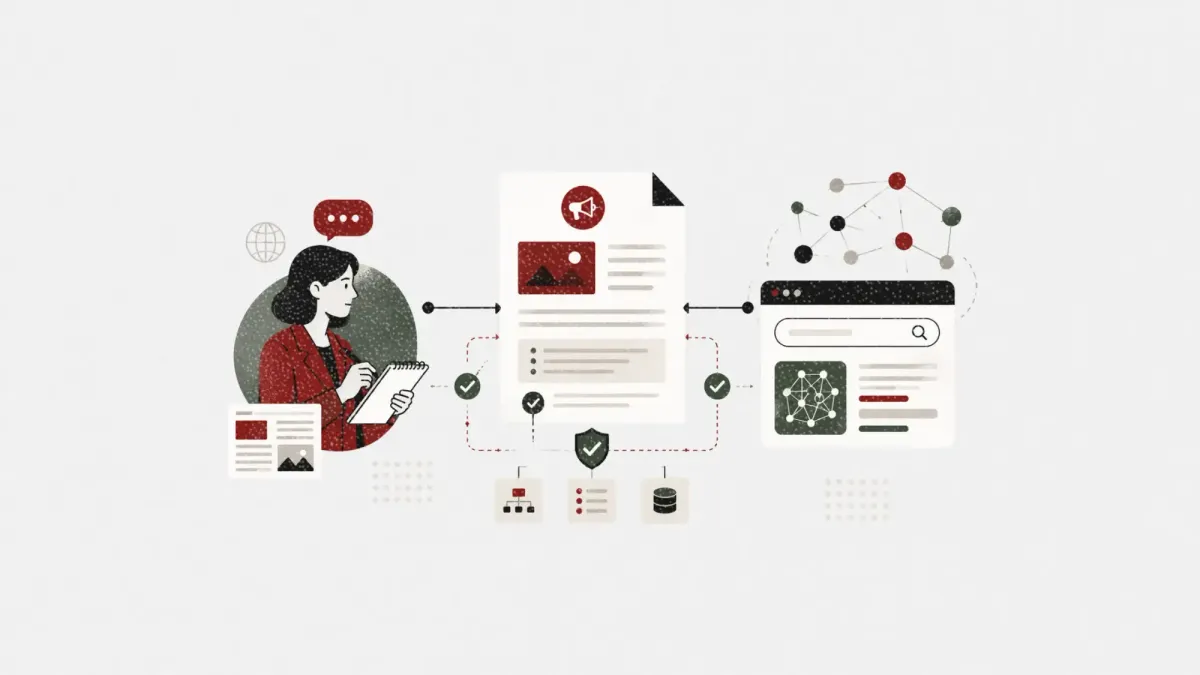
Real media advisory examples worth studying
Recent advisories show how flexible the format can be.
In April 2026, Missouri Governor Mike Kehoe's office used a World Cup security media advisory to invite reporters to a roundtable and press conference with public safety leaders. The advisory worked because the public-interest hook was obvious: FIFA World Cup 2026 security preparations, named participants, and a specific press availability.
In March 2026, the University of Arizona published a Regents' Cup media advisory with a clean what, when, where, and RSVP structure. It is useful as a higher-education example because it does not over-explain the event. It gives reporters the competition, location, schedule window, and contact path quickly.
In April 2026, SAS issued a virtual media briefing advisory for a briefing on agentic AI and quantum. This is the closest B2B example: it shows how an advisory can support an expert-led briefing rather than a physical press conference. The lesson for B2B teams is simple: if the advisory promises access to a timely expert or demo, make the topic and access terms unmistakable.
Together, these examples show the same pattern across government, education, and enterprise technology: the format works when the news value, access, timing, and contact path are immediately visible.
Tools that make advisory workflow easier
The practical workflow is a small operating system that keeps the advisory, media list, spokesperson prep, and follow-up in sync.
Recommended tools include:
- Google Docs or Microsoft Word: Draft the advisory in a format legal, comms, and leadership can review quickly.
- Airtable or Google Sheets: Track target outlets, journalist beats, RSVP status, interview requests, and follow-up notes.
- Muck Rack, Meltwater, CisionOne, or Prowly: Build and segment media lists when the target set goes beyond relationships your team already owns.
- Calendly or Google Calendar appointment slots: Offer interview windows without creating a long back-and-forth thread.
- Google Drive or Dropbox: Host images, logos, speaker headshots, fact sheets, and press kit files in one link.
The important part is consistency. A media advisory is easy to write once. The harder job is making sure every event uses the same checklist, approval path, media list hygiene, and measurement notes.
For teams hosting launches, briefings, and interviews regularly, connect the advisory workflow to spokesperson preparation. ContentGrip's media training guide is a useful companion because the best advisory in the world cannot rescue an unprepared interview.
How to send and follow up without annoying reporters
A media advisory should go only to reporters who plausibly cover the beat, location, event format, or audience. Do not blast it to every journalist in your CRM. Relevance is the first filter.
Timing depends on the event. For local events, public appearances, or press conferences, send the first advisory a few business days to one week ahead, then send a shorter reminder the day before or morning of the event. For larger industry events where reporters plan schedules early, send it earlier and offer appointment windows.
The follow-up should add value, not guilt. A useful follow-up might say:
"Hi [Name], quick reminder that [event] is happening tomorrow at [time]. [Spokesperson] will be available for 10-minute interviews after the briefing, and there will be a live product demo for photos or video. Happy to reserve a spot if useful."
That gives the reporter a reason to reply. It also avoids the worst follow-up line in PR: "Just checking if you saw my email."
The University of California, Santa Cruz keeps media advisories inside a broader media relations template system, which is a good reminder that advisories should not sit alone. Their media relations templates include draft story, news brief, and advisory resources, which mirrors how PR teams actually move from idea to coverage.
 Enricko Lukman
How to measure whether the advisory worked
Do not measure a media advisory only by how many people opened the email. The point is coverage, access, and relationship progress.
Track:
- Advisory sends by beat and outlet type.
- Replies, RSVPs, declines, and interview requests.
- Journalist attendance or virtual briefing participation.
- Coverage published from attendees and non-attendees.
- Quote pull-through from the event.
- Photo, video, or demo usage.
- Follow-up questions that indicate future story interest.
- Source quality, not just number of mentions.
For a B2B launch, one relevant trade journalist attending and writing a thoughtful piece may matter more than broad pickup from irrelevant sites. For a local event, TV attendance or strong photo use may be the main win. For an analyst-style briefing, the real value may be relationship building that shows up in later coverage.
Before the final report, compare the advisory to the outcome. Did the headline match the story journalists actually covered? Did the listed spokespeople answer the questions reporters asked? Did the logistics create friction? Did the follow-up produce interviews or just inbox noise?
That review is how advisories improve over time. Each one should sharpen your sense of which events deserve media attention, which reporters respond to which access opportunities, and which story angles survive contact with the outside world.
A media advisory is not a formality. It is a promise to journalists that the event is worth their limited time. Keep it short, specific, and useful, and it becomes a quiet but powerful part of how PR teams turn planned moments into earned visibility.