Press conference checklist: how PR teams should plan live media events
A practical press conference checklist for PR teams covering news value, media invites, spokesperson prep, press kits, Q&A, and reporting.

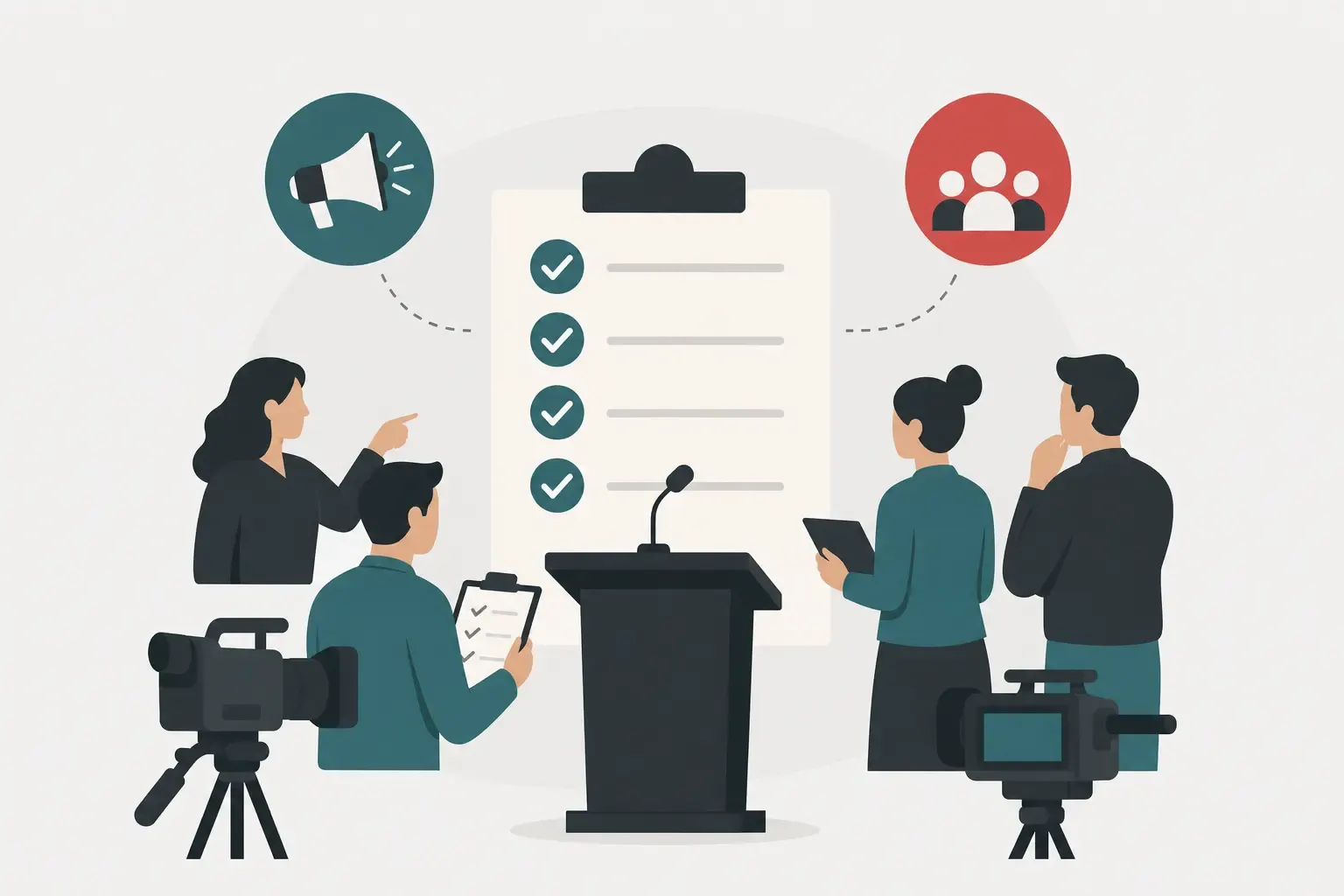
A press conference checklist helps PR teams decide whether a live media event is worth running, then keeps the announcement, spokespersons, logistics, media assets, and follow-up on track. The point is not to create a longer event plan. The point is to make sure journalists get a real story, credible access, usable material, and clear answers in one controlled moment.
That matters because press conferences are expensive in attention. A weak one can burn media trust faster than a weak email pitch because it asks reporters to show up, wait, record, ask questions, and still decide whether the story was worth covering. A strong checklist gives the team a practical test before anyone books a room or sends an advisory.
Key Takeaways
- A press conference only deserves the format when journalists need live access, questions, visuals, or coordinated context.
- The strongest checklist starts with news value and spokesperson readiness before venue, slides, cameras, or refreshments.
- PR teams should measure a press conference by journalist quality, question depth, coverage accuracy, follow-up requests, and message pull-through.
Table of contents
Jump to each section:
- What is a press conference checklist?
- When should PR teams hold a press conference?
- What should be on a press conference checklist?
- How should PR teams plan the press conference timeline?
- What should journalists receive before and during the event?
- How should PR teams manage the room and Q&A?
- How do you measure whether a press conference worked?
- What mistakes make press conferences fail?
What is a press conference checklist?
A press conference checklist is a planning tool that covers news value, speakers, media invitations, assets, logistics, Q&A control, and post-event follow-up.
Use ContentGrip's media advisory guide when the event needs a clear invitation, but use this checklist to decide whether the event itself is strong enough to justify journalists' time.
A useful checklist does two jobs. First, it protects the team from holding a press conference for an announcement that should have been a pitch, release, briefing, or owned-content update. Second, it gives every person involved a clear role before the event becomes public.
The strongest checklists are not just logistics lists. Venue, microphones, parking, recording, livestreaming, and signage matter, but they come after the harder question: will a journalist leave with a clearer, more reportable story than they had before arriving?
Competitor pages in the current search results tend to cover basic event tasks. Checklist.com, for example, lists preliminary actions, statements, room setup, media kits, and follow-up tasks. The University of Kansas Community Tool Box goes deeper on community organizing, timing, press kits, moderator duties, and post-event outreach. Those are useful foundations, but B2B PR teams also need a sharper test for spokesperson credibility, narrative control, and earned-media outcomes.
When should PR teams hold a press conference?
PR teams should hold a press conference only when the story needs live access, coordinated questions, visuals, multiple stakeholders, or immediate public accountability.
Most company announcements do not need a press conference. A product launch, partnership, funding round, appointment, or research release can often be handled with a targeted pitch, a press release, or a smaller media briefing. A press conference is worth the extra effort when live interaction adds value.
Use this decision table before committing to the format:
| Format | Best use case | Risk if misused |
|---|---|---|
| Press release | A factual announcement that can stand on written details. | The story may feel thin if the release tries to replace access or proof. |
| Media briefing | A complex story that needs context, background, or expert explanation. | The session may become too narrow if the story actually needs public visibility. |
| Press conference | A high-stakes or visual announcement where reporters need live access and Q&A. | The event can damage trust if journalists attend and find no real news. |
| Exclusive pitch | A story that benefits from one reporter going deep before broader release. | The team can lose wider momentum if the exclusive is poorly timed. |
Good candidates include a major company milestone, executive change with market implications, crisis response, policy update, product reveal with demos, research findings with senior experts, local launch, public partnership, or event where journalists need photos and quotes on the day.
86% of journalists said at least some of their work began with a PR pitch, while 88% delete pitches that miss their beat, according to Muck Rack's 2026 State of Journalism report.
That is the filter for a press conference, too. The format can open doors, but relevance still decides whether the story gets covered.
What should be on a press conference checklist?
A press conference checklist should cover the story, spokespersons, audience, media assets, logistics, approval process, live Q&A, and follow-up plan.
Build the checklist around decisions, not chores. The goal is to remove uncertainty before journalists enter the room.
- Define the news hook. Write one sentence that explains what changed, why it matters now, and who is affected.
- Choose the journalist audience. List the beats that should care, then name the specific reporters, editors, producers, or creators you want in the room.
- Confirm the spokesperson lineup. Assign one lead speaker, one technical or subject expert, and one backup who can handle follow-up interviews.
- Prepare the message map. Lock the primary message, supporting proof points, boundaries, and approved language for sensitive topics.
- Write the media advisory. Include who, what, when, where, why it matters, interview access, visual opportunities, RSVP instructions, and media contact details.
- Build the press kit. Include the press release, speaker bios, company background, product or campaign assets, images, charts, video links, and fact sheet.
- Set the Q&A rules. Decide who moderates, how questions are taken, which topics are out of scope, and when one-on-one interviews happen.
- Test logistics. Check microphones, lighting, Wi-Fi, recording, signage, seating, camera lines, livestream settings, accessibility, parking, and security.
- Plan follow-up. Assign owners for journalist thank-yous, transcript sharing, asset delivery, corrections, coverage monitoring, and internal reporting.
For B2B teams, the message map is especially important. Technical announcements can collapse under vague executive language. Crisis updates can drift into legal hedging. Funding announcements can sound like investor theatre if the team cannot explain customer impact. A checklist should force the team to make those choices before the public moment.
Tommy Prayoga, Head of Agency at digital PR service provider Content Collision: "The checklist is not there to make the event look organized. It is there to protect the story. If the team cannot say why journalists need to hear this live, who can answer the hard questions, and what proof they will leave with, the press conference is probably the wrong format."
How should PR teams plan the press conference timeline?
PR teams should plan backward from the event date, with separate deadlines for story approval, media outreach, spokesperson prep, logistics, and post-event follow-up.
The exact timeline depends on urgency. A crisis update may happen within hours. A product launch or partnership announcement may need several weeks. Either way, backward planning keeps the team from treating media outreach as the final step.
Use this practical timeline as a starting point:
| Timing | Priority work | Owner |
|---|---|---|
| 2 to 3 weeks before | Confirm news value, message map, speaker lineup, media list, location, and approval path. | PR lead |
| 7 to 10 days before | Send the advisory, brief spokespeople, draft press materials, and test the visual story. | PR lead and comms manager |
| 2 to 3 days before | Confirm RSVPs, run Q&A rehearsal, finalize assets, check technical setup, and prepare follow-up emails. | Event owner |
| Event day | Manage arrivals, record the session, moderate Q&A, handle interviews, and capture questions for follow-up. | Moderator and PR team |
| Same day after event | Send materials, answer open questions, share usable assets, and log journalist interest. | Media relations owner |
ContentGrip's older Tap Insure case study shows one fast version of this workflow: the team executed a press conference in seven days and emphasized message relevance, journalist targeting, clear invitations, exclusivity, doorstop interviews, and follow-up. That article is a useful case study, but a standing checklist should be reusable across launches, crises, events, and executive announcements.
What should journalists receive before and during the event?
Journalists should receive enough information to decide whether to attend, plus enough verified material to report accurately after the event.
Before the event, send a media advisory rather than a bloated pitch. The advisory should explain the news hook, speaker access, timing, location, RSVP process, embargo terms if any, and the kind of visuals or interviews available.
During the event, give journalists a clean press kit. This is where many teams either overstuff the package or leave reporters chasing basic details. A useful kit includes:
- The final press release or holding statement.
- Speaker names, titles, and short bios.
- Company boilerplate and media contact.
- Product, event, or campaign fact sheet.
- High-resolution logos, images, screenshots, and video assets.
- Relevant charts, methodology notes, or source material.
- Approved quotes and spokesperson availability.
- Recording, transcript, or livestream replay timing if available.
Use ContentGrip's press kit examples guide to structure the asset layer behind the announcement. The press kit should reduce back-and-forth, not create a file dump that buries the story.
9 in 10 companies include multimedia in press releases, and 91% reuse press release content on other channels, according to PR Newswire's 2025 global report.
For press conferences, that makes asset discipline even more important. Photos, charts, clips, and product visuals can extend the event beyond the room, but only when they are ready, rights-cleared, easy to download, and matched to the core story.
How should PR teams manage the room and Q&A?
PR teams should manage the room with a clear moderator, prepared speakers, timed remarks, controlled Q&A, and fast follow-up for unanswered questions.
The room should make reporting easier. That means clear sightlines, working audio, visible name cards, good lighting, a sign-in process, and a media contact who can solve practical problems without interrupting the speakers.
The moderator carries more weight than many teams expect. A good moderator opens the session, introduces speakers, explains timing, keeps answers focused, redirects off-topic questions, and closes with next steps. The moderator should also know when to stop a rambling executive before the quote becomes unusable.
Spokespeople should prepare for three kinds of questions:
- Clarifying questions about facts, timing, numbers, product details, roles, or next steps.
- Challenge questions about risks, criticism, delays, tradeoffs, competitors, or accountability.
- Angle questions that help a journalist connect the announcement to a broader trend, market shift, or reader problem.
This is where media training pays off. The spokesperson does not need to sound scripted. They need to be accurate, brief, quotable, and calm when the hard version of the question arrives.
Keep opening remarks short. A press conference is not a keynote. If every speaker reads a full prepared statement, the event becomes slow and journalists get less time for the part they came for: questions, access, and useful quotes.
How do you measure whether a press conference worked?
Measure a press conference by attendance quality, journalist engagement, coverage accuracy, message pull-through, follow-up requests, and reusable content created.
Do not measure the event only by attendance. Ten relevant journalists can be better than 50 general attendees if the right reporters ask strong questions, request interviews, and publish accurate coverage.
Track these metrics in a post-event report:
| Metric | What it tells you |
|---|---|
| Target journalist attendance | Whether the media list and advisory reached the right people. |
| Question quality | Whether reporters understood the story and saw enough substance to probe deeper. |
| Coverage accuracy | Whether key facts, names, numbers, and context landed correctly. |
| Message pull-through | Whether the intended message appeared naturally in coverage, headlines, quotes, or summaries. |
| Follow-up requests | Whether journalists wanted interviews, assets, data, or clarification after the event. |
| Asset reuse | Whether photos, clips, quotes, or charts became useful in earned, owned, social, or sales channels. |
For PR reporting, pair the event metrics with message pull-through analysis. A press conference can generate coverage and still fail strategically if the coverage misses the main point, repeats the wrong frame, or quotes the least useful part of the session.
What mistakes make press conferences fail?
Press conferences fail when the story lacks news value, the wrong journalists are invited, speakers are underprepared, or follow-up is too slow.
The most common failure is format inflation. A team wants the announcement to feel important, so it chooses the biggest-looking format. Journalists can usually tell when the live event exists to make the company feel visible rather than to help the media report something useful.
Avoid these mistakes:
- Holding a press conference for routine news. Use a pitch, release, or owned-content update when there is no need for live Q&A.
- Inviting broad media instead of relevant reporters. Attendance quality matters more than the size of the room.
- Skipping hard-question prep. If the team cannot answer obvious pushback, the event will expose that gap.
- Overloading speakers. Too many executives dilute the story and leave less time for journalist questions.
- Treating the press kit as an afterthought. Reporters need accurate names, facts, images, and contacts quickly.
- Letting follow-up drift. Same-day follow-up often decides whether a journalist can file accurately on deadline.
The final test is simple: if the press conference does not give journalists better access, clearer proof, or a more reportable story than a written release would, choose a smaller format.
That restraint is not a downgrade. It is good media relations. The best PR teams use press conferences when the format genuinely serves the story, then use the checklist to make every minute useful for the journalists who show up.