B2B influencer marketing is becoming a revenue channel. Most teams still run it like social.
B2B influencer marketing is shifting from awareness to pipeline. Use this strategy for attribution, contracts, compliance, and creator fit.

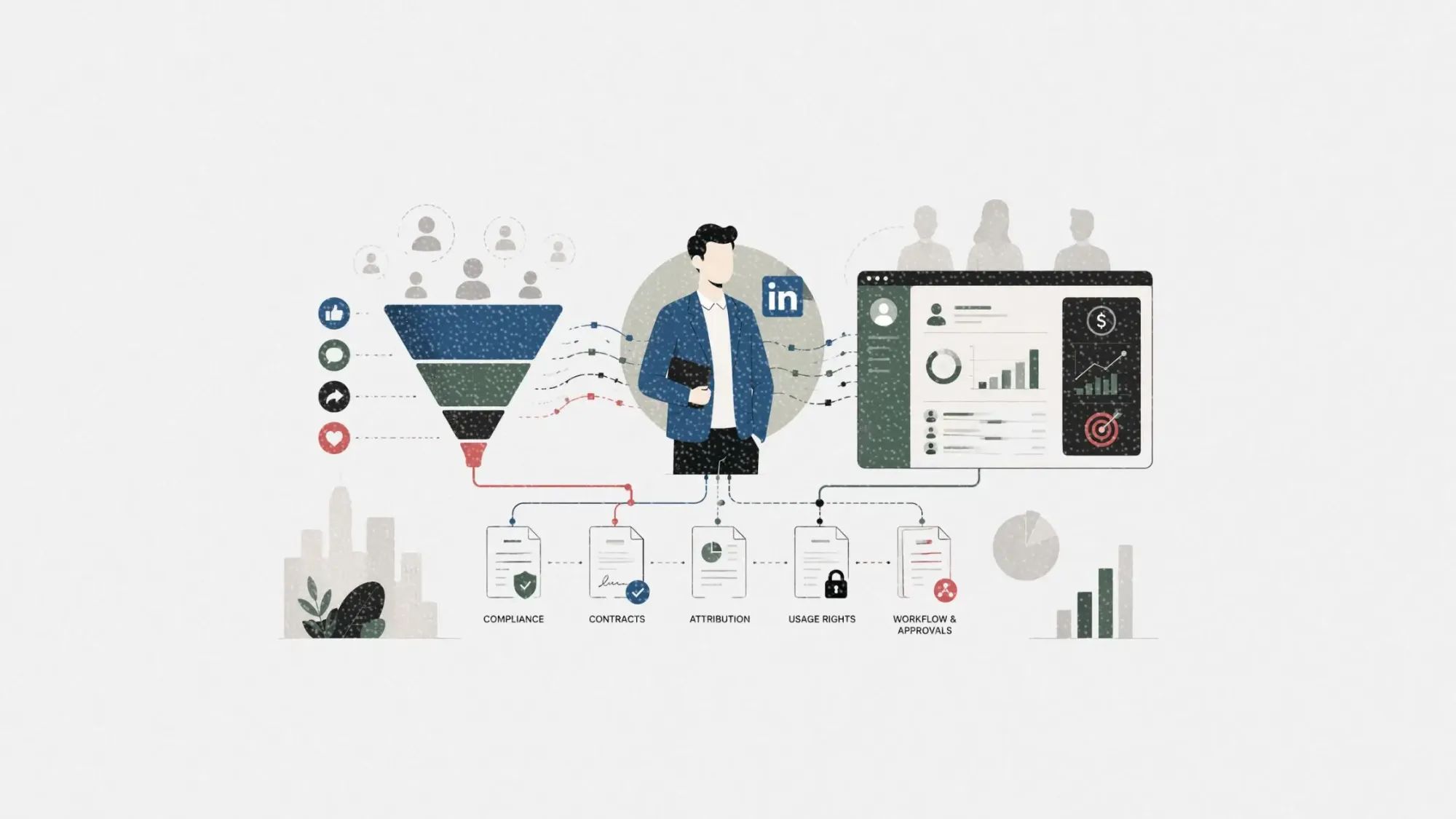
B2B influencer marketing is no longer a side experiment for brand awareness teams. The stronger signal now is organizational: creator programs are moving closer to demand generation, buyer education, and pipeline influence, while many teams still manage them with consumer-style briefs, loose measurement, and lightweight legal review.
That mismatch is where value gets lost. Over the past seven days, ContentGrip's coverage has clustered around the same operator problem from different angles: LinkedIn creator strategy, attribution, contracts, and fraud are no longer adjacent concerns. They are the operating model.
If you still treat B2B influencer work as a social add-on, you will struggle to prove ROI, protect brand trust, or scale the program beyond one-off activations.
Table of contents
Jump to each section:
- B2B influence is now being funded like infrastructure
- The real bottleneck is operations, not creator supply
- Influence reaches buyers your sales team often cannot
- What a B2B influencer operating model actually needs
- How to reorganize before the next creator brief
B2B influence is now being funded like infrastructure
The budget signal is already clear. LinkedIn’s 2025 B2B Marketing Benchmark says 55% of B2B marketers are already running influencer programs, and marketers using creators report 39-point gains in brand awareness and customer engagement plus 30-point increases in lead generation and revenue. That is not experimental behavior. That is a channel moving into the core mix.
The investment logic is widening beyond pilot budgets too. CreatorIQ’s 2025-2026 State of Creator Marketing found that 85% of enterprise organizations plan to increase investment in creator marketing over the next five years. More importantly, the report frames the main barriers as operational rather than financial.
That is a useful distinction for B2B leaders. The market is no longer asking whether creator programs belong in serious marketing plans. It is asking whether teams can run them with enough control to justify more spend.
That is why the strongest recent coverage did not revolve around celebrity endorsements or viral formats. It revolved around system design. Once influence affects brand trust, paid amplification, CRM handoff, and pipeline reporting, the conversation shifts from “Should we try this?” to “Who owns this, how do we govern it, and what counts as success?”
 Enricko Lukman
The real bottleneck is operations, not creator supply
Most B2B teams do not fail at influencer marketing because they cannot find creators. They fail because the machinery around the creator is thin. A weak contract, an unclear usage-rights clause, missing UTM discipline, or no fraud screen can quietly turn a promising program into a reporting argument.
CreatorIQ’s research is especially revealing here. Creators say they want better briefs, clearer guidelines, upfront clarity on metrics of success, and fairer compensation for usage. That should sound familiar to any senior operator.
These are not creative complaints. They are workflow complaints. They point to the same underlying issue: many brands still buy creator output as if they were buying a post, when they are really buying a mix of distribution, trust transfer, repurposing rights, and paid media optionality.
ContentGrip’s recent pieces on the contract clauses B2B teams actually need and on fraud detection before a campaign goes live make the same point from opposite sides. One is about preserving value you paid for. The other is about avoiding value that was never real. Together they describe the real operating gap: B2B brands are increasingly buying influence in environments where rights, authenticity, and downstream reuse matter more than simple reach.
If that sounds closer to media operations than social publishing, that is because it is.
Influence reaches buyers your sales team often cannot
The deeper reason B2B influencer programs are moving up the priority list is not that creators are trendy. It is that buyer groups are harder to reach through direct selling alone. The strongest current evidence comes from the 2025 Edelman-LinkedIn B2B Thought Leadership Impact Report, which found that more than 40% of B2B deals stall because buying groups are misaligned. It also found that 71% of hidden decision-makers have relatively little or no interaction with sales, yet 79% say they are more likely to advocate for proposals from companies that consistently produce high-quality thought leadership.
That matters because many B2B creator programs are really thought leadership distribution programs in disguise. They work when a trusted operator, analyst, customer, or category expert helps your point of view reach people who are influential in the deal but difficult to identify in advance. They fail when teams measure them as short-window engagement plays and ignore how trust accumulates across a longer buying cycle.
This is why ContentGrip’s recent guide to connecting creator activity to pipeline is more important than it may first appear. The operational challenge is not proving that people saw the content. It is proving that creator-led influence changed the shape of the opportunity, warmed hidden buyers, or improved conversion later in the funnel. If your reporting model cannot see that, your program will look softer than it really is and will be judged unfairly against channels with cleaner last-touch visibility.
What a B2B influencer operating model actually needs
The next-stage B2B influencer program needs four things.
First, it needs audience-fit discipline. The creator is not the product. The audience density around the creator is the product. In B2B, a smaller operator with trust inside a narrow buying community can outperform a much larger account with broader but less relevant reach.
Second, it needs rights and amplification logic decided before content is made. A creator post that may later be reused in paid, sales enablement, webinars, event promotion, or customer proof should be contracted that way from day one. Otherwise your best-performing asset becomes legally awkward the moment another team wants to scale it.
Third, it needs measurement that starts with influence and ends in revenue. That means campaign naming conventions, CRM fields, landing-page discipline, attribution windows that fit a real sales cycle, and reporting that can separate creator-assisted pipeline from vanity engagement.
Fourth, it needs compliance that matches the stakes. The FTC’s refreshed Disclosures 101 for Social Media Influencers makes the disclosure standard plain: material relationships must be disclosed clearly and where people will actually see them, including in videos and Stories-style formats. For B2B brands, that is not just a legal hygiene issue. It is part of trust maintenance. A program designed to borrow credibility loses its economic logic the moment the disclosure practice looks evasive.
ContentGrip Staff
How to reorganize before the next creator brief
The practical move now is to stop treating B2B influencer marketing as a content request flowing through social. It should sit closer to a shared operating layer between demand generation, content, paid media, brand, legal, and revenue operations.
The simplest test is this: if a creator partnership performs well, can your team amplify it, attribute it, reuse it, disclose it properly, and explain its business value without rebuilding the process halfway through? If the answer is no, the bottleneck is not creator performance. It is internal design.
Teams that get ahead here will not necessarily have the biggest rosters or the loudest campaigns. They will have tighter briefs, clearer rights, stronger data capture, and a better understanding of which buyers creator-led trust can move. In B2B, that is what turns influence from a social tactic into a revenue channel.